



Waking up from implant surgery with a numb lip can be expected at first. Local anesthetic is designed to block feeling, and that effect can last several hours after you leave the chair.
Understanding numbness after dental implant surgery can help you tell the difference between normal recovery and a symptom that deserves attention.
Most numbness after dental implant surgery fades as the anesthetic wears off, usually within 2 to 8 hours depending on the type used.
Some patients notice tingling or patchy feeling for a few more days while post-operative swelling settles.
If numbness in your lip, chin, gum, or tongue is still present 24 to 48 hours after surgery, that is the point to call your treating clinician, not wait it out.
Numbness after a dental implant does not automatically mean nerve damage. Nerves react to pressure, swelling, and bruising, and many of those reactions settle on their own.
Still, when an implant sits too close to a nerve, the timing of the next step can change the outcome, which is why altered sensation is worth a phone call instead of a wait-and-see week.
Key Takeaways
- Numbness that outlasts the anesthetic by more than 24 to 48 hours deserves a same-day call to your implant clinician.
- Lower-jaw implants carry the sensory risk because the inferior alveolar and mental nerves run through the mandible.
- Imaging and sensory testing guide whether the implant needs adjustment, removal, or specialist referral.
Which Sensations Are Normal, and Which Are Red Flags?
Normal recovery feels like fading numbness that gives way to ordinary soreness, while nerve-related symptoms feel electric, burning, or stubbornly absent.
The pattern over hours and days tells you more than any single sensation does.
Symptoms That May Occur as Anesthesia and Swelling Resolve
As the anesthetic fades, many people feel pins and needles in the lip or chin. That fizzy, waking-up feeling is the nerve resuming normal signaling, and it typically passes within a few hours.
Post-operative swelling can also press lightly on nearby tissue, causing brief reduced sensation or mild hypersensitivity near the implant site. Swelling peaks around day 2 or 3, then eases.
Mild soreness that improves a little each day fits a normal dental implant healing pain timeline. So does slight tenderness when you brush near the site.
Signs of Possible Nerve Injury That Need Prompt Attention
Certain symptoms point toward nerve damage symptoms and should prompt a call the same day you notice them:
- Numbness lasting more than 48 hours after the anesthetic should have worn off
- Electric shock sensations shooting through the lip, chin, or tongue
- A burning sensation or ache that feels different from surgical soreness
- Altered taste or a metallic taste on one side
- Drooling, biting your lip without feeling it, or trouble with speech
- Tingling that has not improved after 2 to 4 weeks
Neuropathic pain, meaning pain coming from the nerve itself, can be harder to treat when it goes unaddressed.
Why Lower-Jaw Implants Can Affect Sensation
Sensory problems after implant placement are mainly a lower-jaw issue, because the mandible houses a large nerve trunk inside the bone.
Upper-jaw implants carry different concerns, such as sinus involvement, and nerve injury there is rare.
The Inferior Alveolar Nerve, Mental Nerve, and Nerve Canal
The inferior alveolar nerve is a branch of the trigeminal nerve. It travels through a tunnel in the lower jawbone called the nerve canal, supplying feeling to your lower teeth, lip, and chin.
Near the premolars, that nerve exits the bone through a small opening and becomes the mental nerve, which handles sensation in your chin and lower lip.
Irritation here produces the classic numb-lip, numb-chin pattern on one side.
These nerves carry feeling only, not muscle control. Your smile and lip movement stay intact, which is why some patients notice numbness without any visible change.
How Implant Positioning, Pressure, and Inflammation Cause Symptoms
Three things during dental implant placement can upset a nerve. The drill or implant can come close to the canal, bone chips and swelling can press on it, or bleeding within the canal can raise pressure around the nerve.
Direct contact is the least common and most serious. Pressure and inflammation are more frequent and often settle as healing progresses, which is part of why early assessment helps: the cause changes the plan.
Implant position drives the decision. Learning how implant placement is planned step by step helps explain why your surgeon measures distance from the canal before drilling.
What to Do When Numbness or Tingling Does Not Improve
Call the office that placed your implant first, even if the numbness feels mild. Timing influences options, and your clinician has the surgical records and imaging needed to interpret what you are feeling.

When to Contact Your Implant Clinician or Oral Surgeon
Make the call the same day if surgical anesthesia has not worn off within 24 to 48 hours.
Contact your surgeon immediately at that point, because early imaging and assessment can determine whether the implant needs adjustment.
Also call for new or worsening lip, chin, or tongue pain weeks after surgery, or when symptoms interfere with eating and speaking.
If sensory changes have not budged after 4 to 6 weeks, ask about referral to an oral and maxillofacial surgeon or a microsurgical nerve repair specialist.
At Minot Dental Partners, post-operative concerns like these are handled as prompt assessments instead of routine appointments, since the useful window for intervention can be short.
How Imaging and Sensory Testing Identify the Cause
Using technology such as a CBCT scan (cone beam CT) shows the implant in three dimensions and measures its exact distance from the nerve canal.
A panoramic x-ray gives a flatter view and can miss overlap, so 3D imaging is the more useful tool here.
Sensory testing maps what you feel. Your clinician uses light touch, pinprick, two-point discrimination, and temperature checks to outline the numb area, then repeats the same tests later to track change over time.
That mapped baseline is the reference point for every follow-up visit. Without it, “a little better” is hard to verify.
When Implant Removal or Specialist Repair May Be Considered
Implant removal or backing the implant out becomes a serious option when imaging shows it encroaching on the canal and symptoms start right away.
Published guidance on implant-related nerve injury supports expeditious removal when acute symptoms suggest neuropathic pain.
Microsurgical nerve repair is reserved for injuries that show no recovery over months, and timing affects the result.
Dental literature on nerve injury referral stresses that timely treatment gives the patient the best chance of a favorable outcome.
Costs for imaging, specialist evaluation, and additional treatment vary based on the care required. Your dental team can explain any recommended next steps after evaluating the cause of your symptoms.
Recovery and Treatment Options for Nerve Symptoms
Most implant-related nerve symptoms improve, and the timeline depends on how the nerve was affected.
Mild compression behaves very differently from a severed fiber, which is why your clinician tracks change rather than predicting an end date.
How Nerve Healing and Neuropraxia Affect Recovery Time
Neuropraxia is the mildest nerve injury: the nerve is bruised or compressed but structurally intact. Feeling usually returns over days to several weeks once pressure is relieved.
More significant injuries involve damage to the nerve fibers themselves.
Nerve recovery then proceeds slowly, roughly a millimeter a day as fibers regrow, so improvement shows up over months.
Signs of healing are worth noting at home: the numb patch shrinking, tingling replacing dead numbness, or pins and needles appearing in a previously silent area. Write down what changes and when.
Managing Neuropathic Pain During Nerve Recovery
When symptoms include burning or shooting pain, standard pain relievers may not address the nerve-related discomfort.
Your treating clinician can evaluate the symptoms and determine whether medication or another approach is appropriate.
Anti-inflammatory medication may be used early when swelling is the suspected cause. Any prescription decision belongs to your treating clinician, who weighs your health history.
Some patients benefit from gentle physical therapy or sensory retraining exercises, which help the brain reinterpret signals from the affected area.
Protect a numb lip while it heals by chewing carefully and checking for accidental bites.
When Ongoing Symptoms May Signal Permanent Nerve Damage
The longer a symptom stays unchanged, the lower the chance of full recovery.
When there is no improvement at all after 6 to 8 weeks, specialist evaluation becomes important, and symptoms persisting past 12 to 18 months are considered unlikely to resolve further.
Permanent nerve damage does not always mean permanent numbness of the whole area.
Many patients end up with a small patch of reduced feeling they adapt to, and sensory retraining helps with that adjustment.
How Careful Planning Helps Protect Nerves
Nerve injury from implants is uncommon, and most of the protection happens before the drill ever touches bone.
Measurement, imaging, and clear safety margins do the heavy lifting.
Why Three-Dimensional Imaging Matters Before Implant Surgery
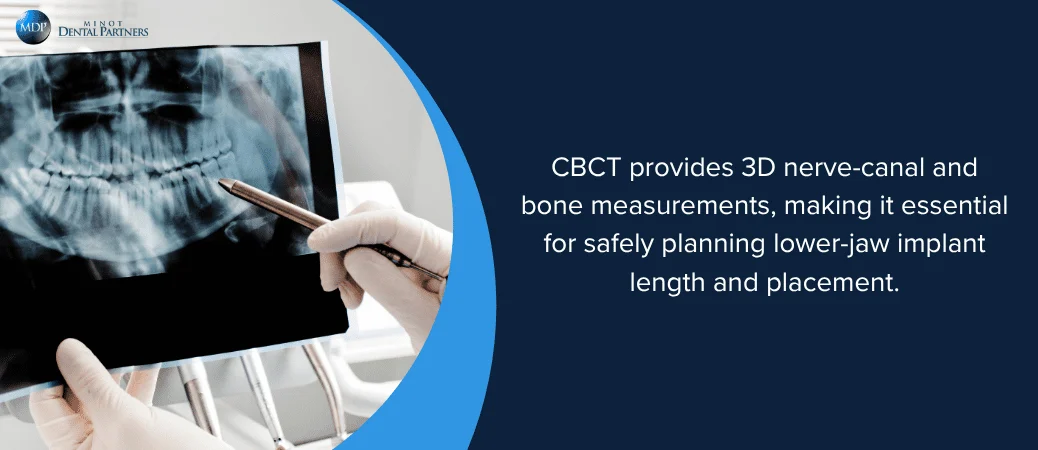
A cone beam CT shows the exact path of the nerve canal and how much bone sits above it.
That information helps your clinician plan implant length and angle while maintaining an appropriate distance from nearby nerve structures.
A panoramic x-ray alone flattens depth and can hide how close the canal really is.
For lower-jaw dental implants, 3D imaging is the planning standard, and it also guides whether bone grafting is needed before implants.
Questions to Ask About Implant Experience and Safety Planning
Reasonable questions before surgery:
- Will a CBCT scan be taken, and will you review the nerve canal position with me?
- How much clearance is planned between the implant and the nerve?
- Will a surgical guide be used?
- Who do I call after hours if numbness lasts longer than expected?
Supporting Healing With Follow-Up and Oral Hygiene
Keep every follow-up appointment, even when you feel fine. Those visits catch changes early, including early signs of dental implant failure that are easier to address at the start.
Good oral hygiene limits inflammation around the healing site: gentle brushing, prescribed rinses, and no poking at the area.
Early Assessment Gives Nerve Symptoms the Best Chance to Improve

Temporary numbness that fades with the anesthetic is part of normal implant recovery.
Persistent numbness, tingling, or burning that lingers past 24 to 48 hours is your cue to call, because implant position and timing shape what can be done next.
Lower-jaw implants sit near the inferior alveolar and mental nerves, so a CBCT scan and mapped sensory testing give your clinician real information instead of guesswork.
Most cases involve pressure or bruising that settles, and nerve recovery shows up as a shrinking numb patch and returning tingling.
Frequently Asked Questions
How long should numbness last after dental implant surgery?
Numbness after dental implant surgery should fade within 2 to 8 hours as the local anesthetic wears off, depending on the type used.
Occasional tingling for a few days while swelling settles is common. Numbness that persists beyond 24 to 48 hours needs a call to your implant clinician.
Can tingling after a dental implant heal on its own?
Yes, tingling from mild nerve bruising or swelling often resolves on its own over days to several weeks.
Have it documented anyway, so your clinician has a baseline to compare against. Tingling that has not improved after 2 to 4 weeks should be reassessed.
Should I call my dentist if the anesthetic has not worn off after 48 hours?
Call right away. Persistent numbness at 48 hours suggests the nerve is under pressure or was irritated during placement, and imaging can show whether the implant needs adjustment. Waiting reduces the options available.
Can an implant be removed if it is pressing on a nerve?
Yes. When imaging shows the implant encroaching on the nerve canal and symptoms began immediately, backing the implant out or removing it is a recognized step, and acting early improves the odds of recovery.
Your surgeon can discuss replacing it later in a safer position.
How do dentists test for nerve damage after implant placement?
Sensory testing maps the affected area using light touch, pinprick, two-point discrimination, and temperature checks, with the numb zone outlined and re-tested at follow-ups.
A CBCT scan shows the implant’s exact position relative to the nerve canal. Together they indicate whether the cause is pressure, inflammation, or direct contact.
Is nerve damage more likely with dental implants in the lower jaw?
Yes. The lower jaw contains the inferior alveolar nerve running through the bone, so implants placed there carry the sensory risk. Upper-jaw implants involve different considerations, such as the sinus, and nerve injury there is rare.