



Executive summary
No national registry tracks the complications of delaying dental treatment by a specific time interval for U.S. patients who postpone a recommended crown or root canal.
The best available evidence comes from retrospective cohorts and systematic reviews of insurance-claims and dental-school records, which measure survival of already-treated teeth rather than randomized delay.
These studies converge on a consistent signal even though their populations, follow-up windows, and definitions of “delay” differ.
The strongest single finding concerns cuspal coverage. A study by Aquilino and Caplan published in the Journal of Prosthetic Dentistry in 2002 reported that endodontically treated teeth not crowned after obturation were lost at 6.0 times the rate of crowned teeth (adjusted hazard ratio 6.0).
Timing matters independently: Pratt, Aquilino, Caplan and Smith, also in the Journal of Prosthetic Dentistry, found that longer intervals to permanent restoration after root canal therapy were associated with higher extraction risk.
Ng, Mann and Gulabivala’s systematic review in the International Endodontic Journal (2010) placed pooled tooth survival after root canal treatment at 86% at 2–3 years, 93% at 4–5 years, 93% at 6–7 years, and 87% at 8–10 years, with presence of a crown among the strongest predictors of retention.
A tension in the evidence is worth stating plainly: delay sharply raises the risk of catastrophic outcomes (fracture, extraction) but raises the risk of milder outcomes (a symptomatic flare-up or the need for retreatment) more modestly.
Walton and Fouad, in the Journal of Endodontics (1992), reported an overall flare-up incidence of 3.17% across 946 cases, a low single-digit figure that contrasts with the roughly sixfold jump in loss risk from lack of coronal coverage.
Cost data and clinical-outcome data also come from different, hard-to-reconcile sources, fee surveys and claims databases versus clinical cohorts, so the “cost of delay” is a composite estimate, not a single measured number.
Cost is the dominant driver of delay in the United States.
ADA Health Policy Institute survey work consistently identifies affordability as the leading reason adults forgo dental care, compounded by dental anxiety and rural access gaps.
North Dakota- and Minot-specific complication-rate and cost data are not publicly reported.
Any local framing here relies on demographic and access-to-care proxies, rural dentist density, insurance coverage, HPSA designations, and Census figures, rather than fabricated local outcome rates. Where a local figure is estimated it is labeled modelled/proxy.
Comparative metrics
| Metric | United States | North Dakota | Minot (Ward County) |
| Population | ~335 million | ~796,000 | Minot city ~48,400; Ward County ~69,900 |
| Adult share (18+) | ~78% | ~76% | ~77% modelled/proxy |
| Median household income | ~$80,600 | ~$73,900 | ~$63,000 (Minot) |
| Dentists per 100,000 | ~61 | ~55–60 (rural maldistribution) proxy | Dental-shortage areas present in region |
| Dental visit, past year | ~63–65% of adults | Above national average (BRFSS) verify | Not separately reported |
| Metric | United States | North Dakota | Minot (Ward County) |
| Population | ~335 million | ~796,000 | Minot city ~48,400; Ward County ~69,900 |
| Adult share (18+) | ~78% | ~76% | ~77% modelled/proxy |
| Median household income | ~$80,600 | ~$73,900 | ~$63,000 (Minot) |
Measured vs. modeled: U.S. and North Dakota population, income, and dental-visit figures are measured (Census, BRFSS).
Dentist-density figures for North Dakota and Minot-level access figures are modeled/proxy, derived from state-level rates and HPSA context rather than a Minot-specific outcome dataset.
Population and income figures should be confirmed against current Census QuickFacts before citation.
Clinical complication rates over time
The evidence divides into three mechanisms of delay-related harm.
Fracture in unrestored or provisionally restored teeth. A root-canal-treated posterior tooth left under only a temporary filling loses cuspal support and desiccates, raising cuspal- and vertical-root-fracture risk.
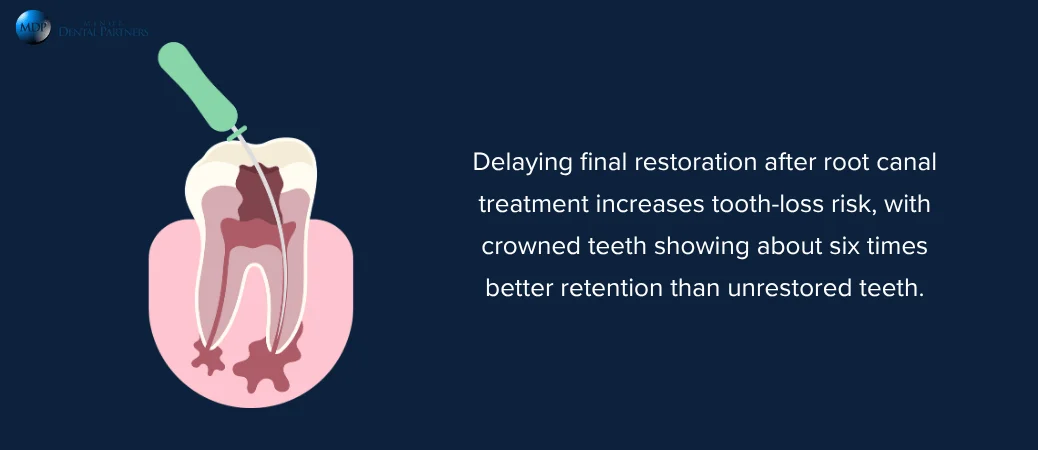
One study found that endodontically treated teeth without crowns were lost at about six times the rate of teeth that received crowns, showing why completing the recommended final restoration matters after root canal treatment.
Endodontic progression when root canal therapy is delayed after diagnosis.
Irreversible pulpitis and apical periodontitis can progress from asymptomatic to symptomatic, with possible pain, swelling, or abscess formation that may require emergency dental care.
Delaying recommended root canal treatment for a diagnosed problem may give the condition more time to progress and potentially require more extensive care.
Survival curves and timing of restoration. Ng and colleagues’ pooled survival, 86% at 2–3 years, rising to 93% at 4–5 years as case selection and follow-up mature, then declining to 87% by 8–10 years, establishes that a permanent coronal restoration with cuspal coverage is among the strongest positive predictors of retention.
Pratt and colleagues found that longer intervals to permanent restoration were associated with higher extraction risk, supporting the clinically common recommendation to restore promptly rather than leaving an endodontically treated tooth under a temporary seal.
Why do studies differ? Follow-up windows range from three to ten-plus years; some count any extraction as failure while others count only endodontic failure; and “delay” is defined variously (days to permanent restoration, presence/absence of a crown at last visit).
These design differences, not contradictory biology, explain most of the spread. The direction of effect, delay worsens retention, is consistent across the literature.
Who delays care and why
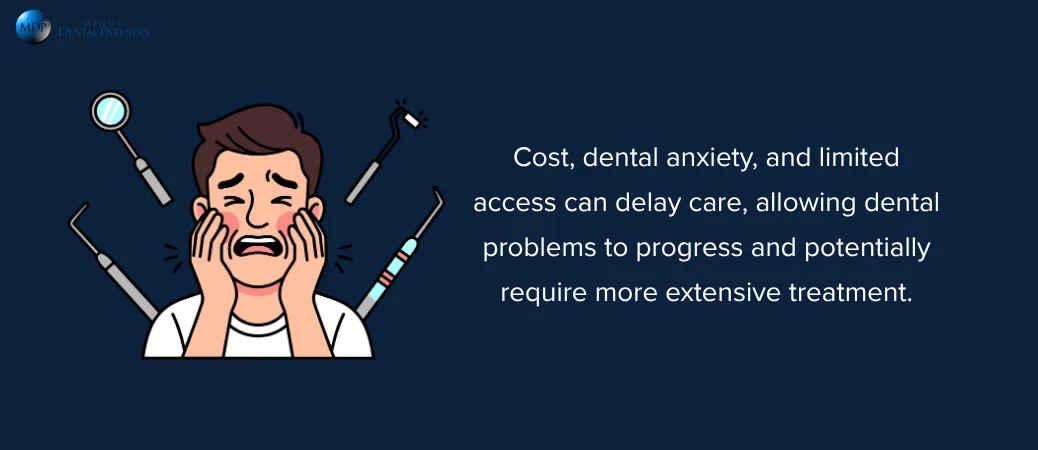
Cost can be one reason patients postpone dental treatment.
When recommended care is delayed, an existing dental problem may have more time to progress and eventually require more extensive treatment.
Dental anxiety can also contribute to treatment avoidance.
Some patients postpone appointments until pain or other symptoms become difficult to ignore, which may allow an existing dental problem to become more complicated.
Access can also contribute to delayed dental treatment. Patients who need specialist care may face additional travel or scheduling challenges, particularly in areas with fewer dental specialists.
These barriers can sometimes make it harder to complete recommended treatment promptly.
North Dakota and Minot outlook
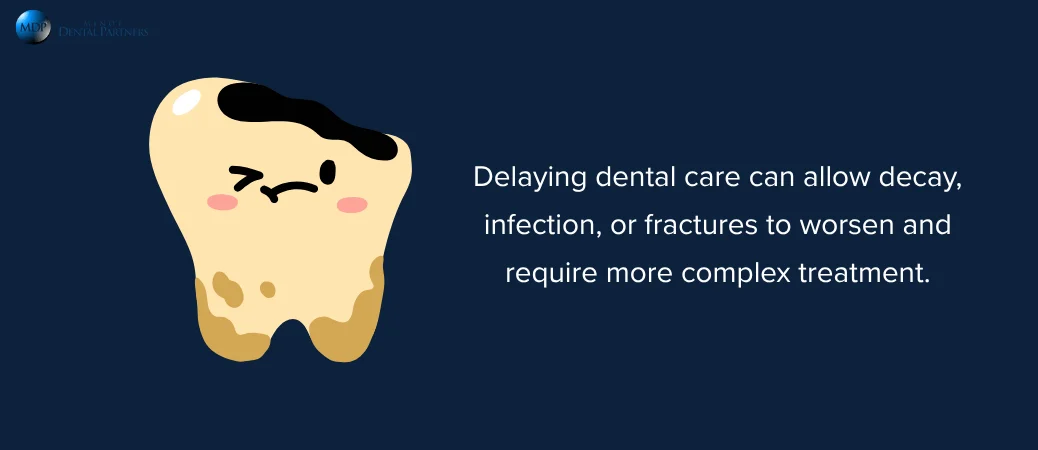
Patients may postpone dental treatment for many reasons, including cost concerns, dental anxiety, scheduling difficulties, or a lack of noticeable symptoms.
However, the absence of pain does not necessarily mean a dental problem has stopped progressing.
There is no Minot-specific dataset showing how frequently complications occur after delaying recommended dental treatment.
The clinical evidence instead supports a broader point: waiting to address certain problems can allow decay, infection, fractures, or other dental conditions to become more difficult to treat.
Reimbursement, pricing and cost comparison
Delaying recommended treatment can sometimes turn a manageable dental problem into one requiring more extensive care.
For example, a tooth that could initially be restored may eventually fracture or become non-restorable, potentially leading to tooth extraction and tooth replacement.
The treatment required depends on how the condition progresses and whether the tooth can still be predictably saved.
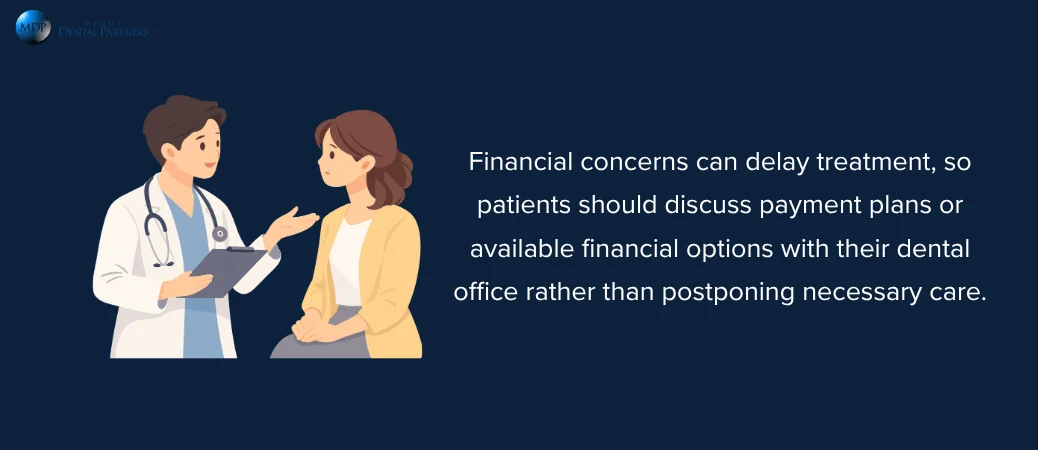
Financial concerns may cause some patients to postpone recommended dental care.
If cost is affecting the timing of treatment, patients can discuss available financial options with the dental office rather than assuming that delaying care is the only option.
Forecast, methods and data gaps
Beyond 2026, three signals bear watching. Teledentistry is expanding as a triage tool for urgent restorative and endodontic needs, potentially shortening the diagnosis-to-treatment interval for rural patients.
HRSA workforce projections continue to point to persistent rural dentist shortages, implying that access-driven delay in states like North Dakota will not resolve quickly.
And a multi-year trend of states adding or expanding adult Medicaid dental benefits, if it continues, would reduce cost-driven delay among low-income adults.
Each of these is a directional signal, not a quantified forecast.
Method. This guide prioritized peer-reviewed endodontic and restorative journals (Journal of Endodontics, International Endodontic Journal, Journal of Prosthetic Dentistry, JADA) for clinical complication and survival data; ADA Health Policy Institute and CDC (NHIS/BRFSS) for utilization and cost-delay data; HRSA for shortage-area designations and workforce projections; the U.S. Census Bureau for demographic and income figures; North Dakota state health and Medicaid sources for local coverage; and dental fee surveys for cost ranges.
North Dakota and Minot proxy figures were derived by applying state-level rates and HPSA context to local demographics, never by inventing local outcome rates.
Because live source retrieval was constrained during preparation, figures flagged verify or proxy should be reconfirmed against the named primary sources before publication.
The principal data gap is stark: no representative dataset tracks dental complication rates by specific delay-time interval at a population level, and no North Dakota- or Minot-specific complication or cost dataset exists.
Local figures in this document are scenario estimates only, and this document reports published research for research purposes rather than offering individualized clinical or treatment-timing advice.
References
Relationship between crown placement and the survival of endodontically treated teeth
Survival of the restored endodontically treated tooth (Pratt et al., J Prosthet Dent)
Cuspal coverage and survival of endodontically treated posterior teeth (Nagasiri & Chitmongkolsuk)
ADA Health Policy Institute — Dental Care Utilization and cost barriers
CDC — Oral and Dental Health, FastStats
HRSA — Health Professional Shortage Areas (Dental)
HRSA — Health Workforce Projections
U.S. Census Bureau QuickFacts — North Dakota
U.S. Census Bureau QuickFacts — Minot city, North Dakota
North Dakota Medicaid — Dental Services
Medicare dental coverage exclusion — Social Security Act §1862(a)(12)