


Every time you chew, you place pressure on your teeth and jaw. When you have full-arch implants, that pressure matters even more because the implants rely on bone support, not nerves or ligaments, to absorb force.
Dentists protect full-arch implants by measuring your bite force and designing them to distribute chewing pressure safely across the jaw.
Strong bites, clenching, or grinding can strain implants if not accounted for, but careful design and monitoring reduce that risk.
This article explains the bite force impact on full arch implants and how your dentist carefully plans treatment around chewing pressure. You’ll also learn how simple design decisions and daily care habits help full-arch implants stay stable, functional, and comfortable for many years.
Key Takeaways
- Bite force plays a major role in implant stability and bone health
- Dentists adjust implant design to manage strong chewing pressure
- Ongoing care helps full-arch implants last longer
Understanding Bite Force and Chewing Pressure
Bite force and chewing pressure shape how well you eat, speak, and protect dental implants. Dentists measure these forces to keep full-arch implants stable and comfortable during daily use.
Definition and Importance of Bite Force
Bite force means the pressure your teeth create when you bite down. Dentists often look at maximum bite force or maximal bite force to understand the limits of your masticatory system. This force reflects how your jaw muscles, teeth, and joints work together.
Strong bite force supports better chewing ability and food breakdown. Chewing also starts digestion and supports oral health, as explained in research on the biomechanics of chewing.
Dentists track bite force to protect restorations. Too much occlusal force can stress implants, while too little can reduce chewing efficiency.
Chewing Patterns and Masticatory Performance
Chewing patterns describe how you move your jaw and where you place pressure during eating. Balanced patterns help spread force across teeth or implants. Uneven patterns can overload one area.
Masticatory performance measures how well you break down food. It depends on muscle control, tooth contact, and rhythm. Studies of human bite force and measurement show that steady, controlled force works better than sudden hard bites.
Your chewing efficiency also links to comfort and nutrition. Poor chewing may push you to softer foods, which can affect diet quality and body mass index over time.
Bite Force in Full-Arch Implants vs. Natural Dentition
Full-arch implants handle force differently than natural dentition. Natural teeth have ligaments that sense pressure and adjust force. Implants lack this feedback, so dentists plan carefully.
Implants can restore strong chewing ability, but peak force often stays lower than with natural teeth. This difference helps reduce overload. Denture and implant research shows how designs change force handling, as seen in findings on how dentures impact bite force.
Dentists use materials, implant number, and bite design to control occlusal force. The goal stays simple: stable function without damage.
| Feature | Natural Teeth | Full-Arch Implants |
| Pressure feedback | High | Limited |
| Force control | Automatic | Planned by dentist |
| Load sharing | Ligaments + bone | Bone only |
Factors Affecting Bite Force
Many factors shape your bite force. Masticatory muscle size and health matter most. Jaw shape, age, and gender also play roles.
Dental status affects force levels. Missing teeth, restorations, or pain can lower maximum bite force. Research on factors influencing bite force measurements shows wide variation between people.
Health conditions can change chewing ability. Jaw joint pain often reduces force. Body mass index may also relate to muscle strength and chewing habits. Dentists review all these factors before finalizing a full-arch implant bite.
Strong bite, grinding, or jaw tension can affect implant success if not addressed early. Talk with a dental specialist near Minot, ND, to evaluate and protect your teeth.
Full-Arch Implants and Their Relationship to Bite Force
Your bite force affects comfort, safety, and long-term success with full arch implants. Dentists plan implant number, position, and prosthesis design to match how hard you bite and how you chew.
How Full-Arch Implants Restore Bite Force
Full arch implants anchor a fixed set of teeth to dental implants placed in your jaw. This setup lets you apply stronger, steadier pressure when you chew.
Studies show patients with fixed full-arch bridges can reach bite forces similar to natural teeth, especially with the all-on-4 approach, as noted in research on bite force after fixed full-arch implant rehabilitation.
You gain better control because the prosthesis does not shift. That stability helps spread chewing pressure across implants instead of soft tissue. Dentists adjust the bite to limit stress in high-force areas, like the back teeth, where pressure runs higher.
Osseointegration and Stability
Osseointegration means the implant fuses with your bone. This bond allows your jaw to carry chewing loads safely.
Bone quality, implant size, and placement matter because high bite force can overload weak areas. Reviews on bite force and dental implant treatment explain how dentists factor this into planning.
Stable osseointegration helps protect against bone loss and hardware damage. Dentists also shape the bite so forces travel more straight down the implant, not sideways. This reduces risk from grinding or clenching.
Key factors dentists evaluate
- Bone density and thickness
- Implant diameter and length
- Bite pattern and chewing habits
Comparing All-on-4 Implants to Complete Dentures
All-on-4 implants support a fixed prosthesis using four implants per arch. This design improves force control compared to complete dentures.
Patients with all-on-4 often bite harder and more evenly than denture wearers, who show lower bite force due to movement and gum support alone, according to findings summarized in All-on-4 bite force comparisons.
| Feature | All-on-4 Implants | Complete Dentures |
| Stability | Fixed to bone | Rests on gums |
| Bite force | Higher, controlled | Lower, limited |
| Movement | Minimal | Common |
This difference affects comfort and long-term chewing ability.
Chewing Efficiency and Dietary Freedom
Chewing efficiency improves when implants stay firm under pressure. You can break down food faster and with fewer bites. Implant-supported prostheses allow more even contact across teeth, which supports varied diets.
Dentists still guide food choices during healing. Once healed, many people return to meats, vegetables, and firm foods. Proper bite design remains key, especially if you clench or grind, to protect the implants over time.
Risks to Full-Arch Implants from Excessive Bite Force
Strong chewing pressure can place real stress on full-arch implants. Dentists plan around this risk by studying how force moves through your jaw, how your muscles work, and how habits like grinding affect implant stability.
Implant Failure and Overload
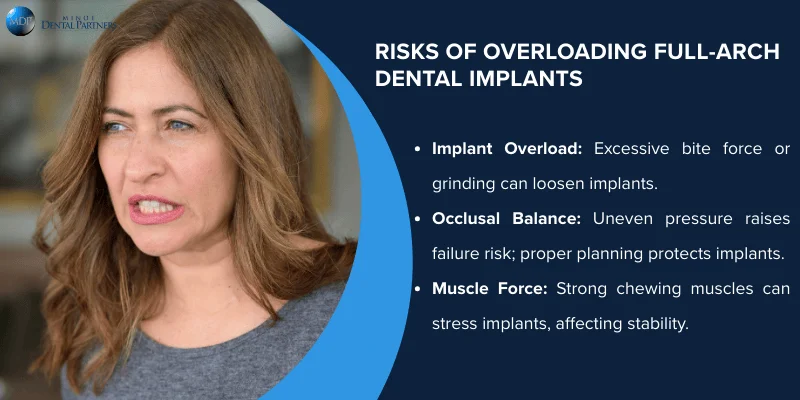
Excessive bite force can overload full-arch implants, especially in the back of the mouth where pressure is highest.
Research shows the posterior bite force can be about three times stronger than the front, which increases the risk of implant failure if the load exceeds what the bone can support. When overload happens, bone around the implant may break down, leading to loosening or loss of integration with the jaw.
Implant placement, size, and number matter when force runs high. Dentists may choose wider or longer implants, or spread them across the arch, to reduce stress.
Studies on bite force and implant treatment show that extreme forces can increase the risk of bone loss and fixture failure when planning does not account for your chewing strength.
Want full-arch implants built to handle your natural chewing strength? Fill out the new patient form online to discuss personalized implant design and pressure-balancing techniques.
Bruxism, Clenching, and Teeth Grinding
Bruxism, clenching, and teeth grinding expose implants to repeated and often sideways forces. These forces differ from normal chewing because they last longer and occur without food to absorb pressure. Over time, this pattern can strain implant components and surrounding bone.
People who grind their teeth can produce very high bite forces, sometimes beyond typical chewing levels. Dental studies note that excessive force from grinding may weaken the implant-to-bone connection, raising the risk of loosening or fracture.
Dentists often recommend night guards or adjust the bite to protect full-arch implants when these habits exist, especially during early healing when implants remain most vulnerable.
Impact of Occlusal Analysis
Occlusal analysis helps your dentist see how and where your teeth contact during biting and chewing. Poor force distribution can overload certain implants while others carry very little load. This imbalance increases the risk of implant failure, even when implants integrate well at first.
During analysis, dentists look for early contacts, uneven pressure, and off-axis forces. Careful occlusal planning can redirect force toward stronger areas of bone and reduce stress on weaker zones.
Clinical reviews on bite force and dental implants show that no single force level predicts failure, but analyzing how force spreads across the arch improves dental implant success over time.
Role of Masticatory Muscles in Force Generation
Your bite force comes from the masticatory muscles, mainly the masseter and temporalis muscles. Strong or overactive muscles can generate very high chewing pressure, regardless of tooth or implant condition. Research shows bite force depends more on muscle strength than on how many teeth you have.
When these muscles contract during clenching or grinding, they can place heavy loads on implants, often in sideways directions.
These off-axis forces challenge implant stability, especially in areas with thin facial bone. Understanding muscle-driven force helps dentists adjust implant placement and bite design to better match your natural chewing patterns and protect long-term implant performance.
How Dentists Assess and Measure Bite Force
Dentists look at how hard you bite, where pressure builds, and how your jaw moves during chewing. They combine physical measurements, movement tracking, and digital analysis to protect full-arch implants from overload and uneven wear.
Bite Force Measurement Devices
Dentists measure bite force using small sensors placed between your teeth. Many tools use a bite fork with built-in pressure sensors that record how much force you apply when you bite down. Healthy adults often produce strong force in the back teeth, which matters most for implant safety.
Common devices include thin electronic sensors and pressure-sensitive films. These tools show force levels in specific areas, not just one total number. Some systems track changes over time to compare results before and after treatment.
Research summarized in studies on bite force measurement devices used in dentistry shows that accurate force data helps dentists adjust implant design and placement.
Dentists also consider personal factors like jaw size and body mass index, since higher muscle mass can increase bite force.
Assessing Chewing Patterns
Bite force alone does not tell the full story. Dentists also study your chewing patterns to see how your teeth and implants work during real movement. They observe which side you favor, how evenly you chew, and how often your teeth contact.
Some patients chew mostly on one side, which can overload implants. Others apply short bursts of high pressure instead of steady force. Dentists may ask you to chew test materials while sensors record timing and pressure.
This process supports detailed occlusal analysis, which checks how your upper and lower teeth meet. Irregular chewing patterns often link to jaw discomfort or past tooth loss. Measuring these patterns helps dentists balance your bite and reduce long-term stress on implants.
Clinical Evaluation and Digital Tools
Dentists combine hands-on exams with digital tools to refine bite analysis. During a clinical exam, they check jaw motion, muscle tenderness, and signs of wear on teeth or implants. These findings help confirm sensor data.
Digital systems like computerized bite analysis map pressure points across your bite in real time. Some tools display color-coded force levels, making overload easy to spot.
Dentists use this data to fine-tune implant position, adjust restorations, and protect your implants during daily chewing.
Design and Protection Strategies for Full-Arch Implants
Dentists plan full-arch implants to manage chewing pressure from day one. They control where implants sit, how many they use, which materials they choose, and how the final teeth fit your bite.
Implant Placement and Number
Your dentist places implants where bone can best handle force. In full-arch cases, this often means angling some implants to spread load and avoid weak bone areas.
Using the right number of implants matters. Fixed dental prostheses commonly use four to six implants per arch, depending on your bite strength and bone quality.
Studies show that patients with fixed full-arch bridges can reach bite forces close to natural teeth, which raises the need for careful planning. Research on bite force after fixed full-arch implant rehabilitation supports this approach.
Dentists also plan implant spacing to reduce bending forces. This helps protect bone and lowers the risk of component failure.
Prosthetic Components and Crown Design
Prosthetic components guide how force moves through your implants. Abutments, screws, and frameworks must work together without flexing or loosening.
Crown design plays a key role. Dentists shape prosthetic teeth to limit sharp biting edges and heavy back-to-front pressure. They also adjust contact points so force spreads evenly across the arch.
For fixed dental prostheses, dentists often reduce cantilevers. Shorter extensions lower stress on implants during chewing. A review of bite force and dental implant treatment explains how high bite force can raise the risk of overload when design does not control pressure well.
Material Selection for Strength and Durability
Material choice affects how well your dental restorations handle force over time. Dentists select materials based on your bite, grinding habits, and arch position.
Common options include zirconia and reinforced acrylic. Zirconia offers high strength and resists wear under heavy chewing pressure. Acrylic absorbs some force but may wear faster.
Your dentist balances strength with repair needs. Stronger materials reduce fractures, while repairable materials make future fixes easier.
Long-lasting implants start with proper planning and bite management. Contact our team today at Minot Dental Partners to learn how we design restorations for strength, comfort, and durability.
CAD/CAM Technology and Customization
CAD/CAM technology lets dentists design restorations that match your bite with precision. Digital scans guide implant placement and prosthetic design before surgery starts.
Custom frameworks fit more accurately than stock parts. This reduces uneven pressure and micro-movement during chewing. CAD/CAM systems also help adjust crown height and angulation to limit off-axis force.
In full-arch cases, customization matters more because small errors affect the whole arch. Detailed design using CAD/CAM technology in full-arch implant protocols supports better load control and longer-lasting results.
Promoting Long-Term Success of Full-Arch Implants
Strong bite force does not have to shorten the life of your implants. Dentists protect full-arch systems by controlling pressure, guiding daily habits, and tracking small changes before they become problems.

Preventive Care and Maintenance
Preventive care plays a direct role in the success of dental implants. Full-arch implants can last many years, but they need routine care to stay stable and comfortable. Dentists schedule maintenance visits to clean hard-to-reach areas and check each prosthetic component.
These visits help reduce plaque buildup and lower the risk of peri-implant disease. Studies on long-term outcomes show that full-arch systems perform best when patients follow structured maintenance plans for the long-term success of full-arch implants and maintenance.
Key goals of maintenance visits include:
- Checking bite balance and wear patterns
- Tightening or replacing worn screws
- Inspecting zirconia or acrylic surfaces for cracks
This approach supports healthy bones and steady chewing function.
Patient Education on Chewing Habits
Your daily chewing habits shape how well implants handle pressure. Full-arch systems spread force across several implants, but poor habits can still overload them. Dentists focus on education so you understand how chewing affects masticatory performance.
You should avoid using implants to bite hard objects like ice or pens. Side-to-side grinding also places stress on prosthetic components. Bite misalignment and grinding can raise the risk of wear, as described in guidance on how bite force and grinding affect dental implant longevity.
Helpful habits include:
- Chewing evenly on both sides
- Wearing a night guard if you grind
- Reporting jaw soreness early
Clear guidance helps you protect your implants every day.
Regular Monitoring and Professional Checkups

Regular checkups allow dentists to catch small issues early. In oral implantology, bite force problems often develop slowly and without pain. Monitoring helps prevent hidden damage to bone or implant connections.
Dentists assess how your bite aligns and how force is distributed across the arch. Proper alignment supports comfort and long-term stability, which experts highlight when discussing the role of bite alignment in successful full-arch restorations.
During checkups, dentists often review:
- Bone levels around implants
- Fit and condition of the prosthesis
- Changes in chewing comfort or strength
Consistent monitoring protects function and keeps your implants working as intended.
Not sure if your bite pattern is safe for implants? Visit our clinic in Minot, ND, for a detailed bite analysis and expert guidance on maintaining implant health.
Frequently Asked Questions
Dentists plan full-arch implants to handle strong bite forces, daily chewing, and long-term wear. They focus on force balance, material choice, and regular follow-up care to protect the implants and the bone that supports them.
What measures can dentists take to ensure full-arch implants withstand daily chewing pressures?
Dentists place implants in positions that spread chewing forces across the jaw instead of loading one spot. This approach helps reduce stress on the bone and implant screws.
They also adjust the bite so your back teeth do most of the chewing work, since the posterior jaw carries much higher bite force than the front teeth.
How often should patients with full-arch implants come in for check-ups to maintain optimal bite force?
Most patients should see their dentist at least twice a year. These visits let your dentist check bite balance and spot early signs of excess pressure.
If you grind your teeth or have a strong bite, your dentist may suggest more frequent visits. Extra monitoring helps prevent loosening or bone loss.
What are the best practices for protecting full-arch dental implants from excessive pressure?
Dentists often recommend a night guard if you clench or grind your teeth. Grinding can place ongoing stress on implants and increase the risk of wear or loosening, especially with high bite force and bruxism.
Regular bite checks and small adjustments also help. These steps keep chewing forces even across the full arch.
Are there specific materials recommended for full-arch implants to handle high bite forces?
Dentists often use strong materials like zirconia for full-arch bridges. These materials resist cracks and hold up well under heavy chewing loads.
Material choice depends on your bite strength and chewing habits. Your dentist matches the material to your specific needs.
Can full-arch implants be adjusted to better distribute chewing pressure?
Yes, dentists can adjust the bite surface after placement. Small changes can reduce high contact points that concentrate pressure.
Some clinics use digital bite analysis to see exactly where forces hit. This technology helps guide precise adjustments, as explained in occlusal load management for implant success.
What lifestyle or dietary advice do dentists give to patients with full-arch implants to minimize damage?
Dentists often recommend avoiding very hard foods such as ice, hard candy, or bones. These foods can cause sudden spikes in blood pressure.
You may also hear advice to cut tough foods into smaller pieces and chew evenly on both sides. These habits help protect your implants during daily use.