



Missing teeth can affect how you eat, speak, and feel about your smile. When you’re ready to replace a tooth, you’ll likely hear about two main options: same-day implants and traditional dental implants. The difference between them comes down to timing, healing requirements, and your specific oral health needs.
Same-day implants let you walk out with a new tooth on the same day as your procedure, while traditional dental implants require several months of healing before your final tooth is attached.
Both methods can restore your smile, but not everyone qualifies for the faster option. Your bone density, gum health, and whether you have infections all play a role in determining which type of tooth replacement works best for you.
Understanding who qualifies for same-day dental implants vs traditional option helps you make the right choice for your situation. The decision involves weighing speed against long-term success rates, considering your budget, and working with your dentist to find what fits your oral health condition.
Key Takeaways
- Same-day implants offer immediate results but require good bone density and healthy gums to qualify
- Traditional implants take longer but work for more patients and have a proven success record
- Your dentist will evaluate your oral health to determine which tooth replacement option suits your needs
What Are Same-Day and Traditional Dental Implants?
Both options replace missing teeth with titanium posts anchored into your jawbone, but they differ in timing and how quickly you receive your final restoration. Same-day implants let you walk out with a temporary crown on the same day, while traditional implants require months of healing before attaching your permanent tooth.
Same-Day Dental Implants Explained
Same-day dental implants, also called immediate load implants, allow you to receive a temporary crown within hours of implant placement. Your dentist places the implant post into your jawbone during a single visit and attaches a temporary restoration right away.
This approach works because the implant procedure relies on immediate stability and precise planning. Your temporary crown looks natural but isn’t designed to handle full chewing pressure while osseointegration occurs.
The implant still needs time to fuse with your bone over several months. Once healing completes, your dentist replaces the temporary with a permanent crown or final crown that matches your other teeth perfectly.
Traditional Dental Implants Overview
Traditional implants follow a staged approach that typically spans three to six months. Your dentist first places the implant post into your jawbone, then closes the gum tissue over it to heal undisturbed.
During this healing period, osseointegration occurs as your bone grows around the titanium post to create a stable foundation. You won’t have a visible tooth during this time, though your dentist may provide a temporary denture for appearance.
After complete integration, your dentist reopens the site to attach an abutment, which connects the implant to your final restoration. A custom-made ceramic crown is then placed to complete your new tooth. This method offers proven long-term stability and works well for complex cases.
Types of Implant Solutions
Modern implant dentistry offers several options beyond single-tooth replacements:
- Single implants: Replace one missing tooth with an individual implant post and crown
- All-on-4: Secures a full arch of teeth using just four strategically placed implants
- Implant-supported bridges: Connect multiple teeth using two or more implants as anchors
- Implant-retained dentures: Snap onto implants for better stability than traditional dentures
- Zygomatic implants: Anchor into cheekbone when jawbone density is insufficient
Your specific situation determines which solution works best. Factors like bone quality, number of missing teeth, and overall health all influence the right choice for restorative dentistry treatment planning.
Ready to explore your implant options in Minot, ND? Get all the information and best services at Minot Dental Partners, and find out whether you qualify for same-day or traditional dental implants.
Candidacy Requirements: Who Qualifies for Each Option?
The path to getting dental implants depends heavily on your oral health and bone structure. Your jawbone density, gum health, and how quickly you need tooth replacement all play major roles in determining which implant option works best for you.
Key Candidacy Criteria for Same-Day Implants
Same-day implants require specific conditions to work properly. You need sufficient bone density to support immediate placement and loading of the implant. Your dentist will check if your jawbone can provide strong initial stability for the implant post.
Patients with significant bone loss or gum disease are typically not good candidates for same-day procedures. Your gums must be healthy and free from active infections. If you have untreated periodontal disease, you’ll need to address that first.
Your overall health matters too. You should be a non-smoker or willing to quit, as smoking reduces implant success rates. People with uncontrolled diabetes or certain autoimmune conditions may not qualify for the immediate load approach.
The location of your missing tooth also affects candidacy. Front teeth often work better for same-day replacement than back molars, which handle more chewing pressure.
Key Candidacy Criteria for Traditional Implants
Traditional dental implants work for a wider range of patients because they allow more healing time. You can qualify even if your bone density isn’t perfect initially. The staged approach gives your jawbone time to strengthen and integrate with the implant through osseointegration.
If you need a bone graft or sinus lift, traditional implants are usually your best option. These procedures require several months of healing before implant placement. Traditional implants offer greater predictability for complex cases like full-arch restorations.
You might prefer this method if you have multiple missing teeth or experienced significant tooth loss. The extended timeline allows for proper soft tissue healing between surgical stages. Traditional implants accommodate patients who need extensive preparatory work before implant placement.
The Role of Jawbone Density and Bone Structure
Your jawbone density directly determines implant stability and success. Dense, healthy bone can hold an implant firmly in place from day one. Thinner or weaker bone may need reinforcement through bone grafting before any implant procedure.
Dentists measure bone density using CT scans or X-rays. They look at both bone quality and quantity in the implant site.
A clinical research study on dental implant criteria found that having sufficient bone height and width at the implant site was one of the most crucial requirements for treatment success, with insufficient bone often requiring grafting or augmentation prior to placement.
When your jawbone lacks sufficient density, bone grafting becomes necessary. This procedure adds bone material to strengthen weak areas. After a bone graft heals (usually 3-6 months), your jaw can better support an implant.
Your bone structure changes over time after tooth loss. The longer you wait to replace missing teeth, the more bone resorption occurs. This makes early treatment important for preserving your natural jawbone structure.
Ready to find out if you qualify for same-day or traditional dental implants? Schedule your implant evaluation with Minot Dental Partners in Minot, ND. Our experienced team will assess your jawbone health, gum condition, and oral health to recommend the best treatment.
Comparing the Implant Procedures and Recovery
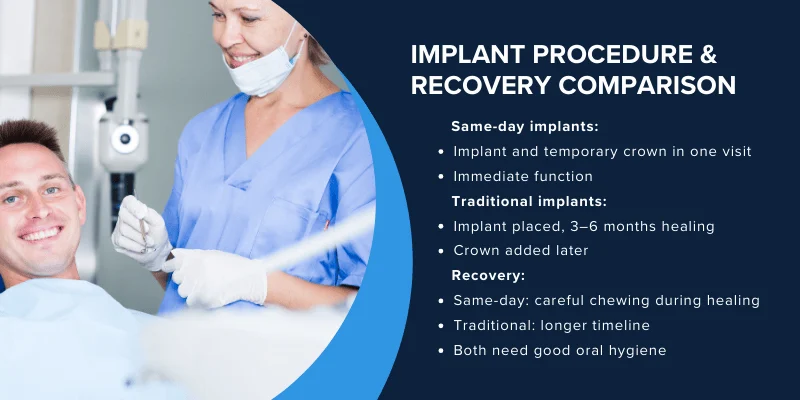
Same-day and traditional dental implant procedures follow different timelines and steps, with the main difference being when you receive your temporary crown. The healing period for both options involves osseointegration, but the approach to restoration timing varies significantly.
Step-by-Step: Same-Day Implant Process
Your same-day implant journey begins with 3D imaging and digital scanning to map your jaw structure precisely. The dental office uses this technology to plan exact implant placement before surgery starts.
During the dental implant procedure, your dentist surgically places the implant post into your jawbone under local anesthesia. The implant post is a small titanium screw that acts as an artificial tooth root. Right after implant placement, your dentist attaches an abutment to the post.
You leave the same appointment with temporary crowns already in place. This means you can eat and smile with a functional tooth immediately, though you’ll need to stick to softer foods initially. The entire process happens in one visit to the dental office, which typically takes a few hours.
Step-by-Step: Traditional Implant Process
Traditional dental implant surgery begins with a thorough consultation where your dentist evaluates your bone density and oral health. During the first surgery, the implant post is placed into your jawbone.
Your gums are then stitched closed over the implant post. You’ll wait 3 to 6 months for complete healing before the next step. This waiting period allows osseointegration to occur, which is when the implant fuses with your natural bone tissue.
After osseointegration completes, you return for a second minor surgery. Your dentist reopens the gum tissue and attaches the abutment to the implant post. A few weeks later, once soft tissue healing finishes around the abutment, your permanent crown is custom-made and attached to complete the restoration.
Healing Period and Recovery Differences
Both implant procedures require osseointegration, but your recovery experience differs based on which option you choose. With same-day implants, you have immediate function but must be careful with your temporary crowns during the 3 to 6 month healing period.
Traditional implants involve a longer overall timeline but may feel less stressful since the implant post heals undisturbed beneath your gums. Soft tissue healing takes 1 to 2 weeks for both procedures, during which you may experience mild swelling and discomfort.
Maintaining excellent oral hygiene is critical for both options. You should brush gently around the surgical site and avoid hard or sticky foods initially. Your dentist will provide specific care instructions based on your individual implant surgery.
The permanent crown placement marks the final stage for both procedures, giving you a fully restored tooth that looks and functions naturally.
Benefits and Drawbacks of Each Implant Method
Both same-day dental implants and traditional implants offer effective tooth replacement, but they come with different advantages and limitations. Understanding how immediate-load implants compare to conventional options helps you make the best choice for your dental health.
Advantages of Same-Day Dental Implants
Same-day dental implants let you walk out of your appointment with a complete smile restoration in just one visit. You won’t need to wait months between procedures or deal with multiple appointments.
The convenience factor is huge. Instead of scheduling several visits over many months, you get your new teeth right away. This means less time off work and fewer trips to the dental office.
You also avoid the discomfort of going without teeth. Traditional implants often require you to wear temporary dentures or go without teeth during the healing period. With same-day implants, you receive immediate teeth on the same day as your surgery.
Key benefits include:
- Immediate function and appearance
- Fewer dental appointments
- Less overall treatment time
- No gap period without teeth
- Quick return to normal activities
Advantages of Traditional Dental Implants
Traditional implants give your jawbone more time to heal and fuse with the implant. This healing period, which takes 3-6 months, creates a stronger foundation for your new tooth.
The two-stage approach used by traditional implants works for more patients. You don’t need perfect bone density or ideal oral health conditions to qualify. If you have bone loss or other dental issues, traditional implants are often still an option.
The success rates for traditional implants are well-documented over decades of use. The extra healing time reduces the risk of implant failure because the implant becomes fully integrated before you put pressure on it.
Main advantages include:
- Higher success rates for complex cases
- Better long-term durability
- Works with lower bone density
- Less risk of implant movement
- Suitable for more patients overall
Potential Risks and Limitations
Same-day dental implants require excellent bone quality and good overall oral health to work properly. If you have insufficient bone density or compromised dental health, you may not qualify for immediate-load implants.
The immediate loading puts more stress on the implant before it fully fuses with your bone. This creates a higher risk of implant movement during the healing process compared to traditional methods.
Traditional implants require patience. You’ll need to wait several months between the implant placement and receiving your final teeth. During this time, you may need temporary solutions or go without teeth in that area.
Common limitations to consider:
| Same-Day Implants | Traditional Implants |
| Need excellent bone quality | Longer treatment timeline |
| Higher initial cost | Multiple appointments required |
| Not suitable for all patients | Temporary gap without teeth |
| Risk of early implant failure | More invasive overall process |
Both methods can affect your daily routine differently during recovery. You need to follow specific care instructions to protect your investment and maintain your oral health regardless of which option you choose.
Cost, Durability, and Long-Term Outlook
Understanding the cost difference between immediate load dental implants and the traditional implant procedure matters when planning your treatment. Both options offer lasting solutions, but they differ in upfront expenses and how insurance companies view them.
Cost of Dental Implants and Insurance
The cost of dental implants varies based on which procedure you choose. Same-day dental implants may be more expensive than traditional implants because they use advanced techniques and materials.
Traditional implants typically range from $3,000 to $4,500 per tooth. Same-day dental implants cost between $3,500 and $6,000 per tooth. The higher price comes from the specialized planning and immediate restoration.
Most dental insurance plans cover only a portion of implant costs. They usually pay 50% of the procedure after you meet your deductible. Some plans treat implants as cosmetic and offer no coverage at all.
Many dentistry practices offer payment plans or financing options. This helps spread the implants cost over several months or years.
Longevity and Success Rates
Traditional implants may take longer to complete but they have a higher success rate in terms of long-term durability. They typically succeed 95% to 98% of the time.
Same-day implants have success rates between 90% and 95%. The slightly lower rate happens because the implant gets loaded with a temporary tooth right away. Both immediate load implants and traditional implants provide durable and long-lasting solutions when properly cared for.
Your final crown gets placed after healing completes. This usually takes three to six months. Both types can last 25 years or more with good care.
A systematic review and meta-analysis examining dental implant survival over a decade found overall survival rates of about 96.4% at 10 years, indicating very high long-term success for traditional implant placement when proper protocols are followed.
Maintaining Your Implants for the Future
Your implants need the same care as natural teeth. Brush twice daily and floss once every day. Use a soft-bristled toothbrush to avoid scratching the crown.
Visit your dentist every six months for cleanings and checkups. These visits help catch problems early. Your dentist will check the implant stability and gum health around it.
Avoid chewing ice or hard candy that could damage your crown. Don’t use your teeth to open packages. If you grind your teeth at night, wear a nightguard to protect your implants.
Smoking reduces blood flow and can cause implant failure. Quitting smoking improves your chances of long-term durability. Regular oral hygiene practices ensure excellent longevity for your investment.
Is Same-Day or Traditional Right For You?
Your choice between same-day and traditional implants depends on your daily routine, health status, and how involved you want to be in the planning process. Both implant solutions offer effective restorative dentistry outcomes when matched to the right person.
Lifestyle and Personal Preferences
Your work schedule and social commitments play a big role in choosing between these implant solutions. Same-day implants require fewer appointments, which works well if you have limited time off or a busy calendar.
If you need an immediate smile for work presentations or social events, same-day options restore your appearance right away. Traditional implants mean waiting several months with a gap or temporary denture, which some people find uncomfortable in professional settings.
Your eating habits matter too. Same-day implants require a strict soft-food diet for months while healing happens. If you’re not willing to avoid hard or crunchy foods during recovery, traditional implants might suit you better since the healing occurs before any tooth is attached.
Budget considerations:
- Same-day implants often cost more upfront due to the specialized procedure
- Traditional implants spread costs across multiple visits
- Some insurance plans cover one type more than the other
Your commitment to oral hygiene affects success rates for both options, but same-day implants demand extra careful cleaning during the healing phase.
Consultation and Decision-Making Process
A thorough consultation includes 3D scans and bone density measurements to determine which restorative dentistry approach fits your dental health situation. Your dentist will evaluate your jawbone quality, gum condition, and overall health before recommending either option.
Ask specific questions during your consultation. Find out if you need bone grafting, which eliminates same-day implants as an option. Request success rate data from the practice for both procedures.
Bring up any medications you take or health conditions like diabetes that could affect healing. Be honest about smoking habits since this impacts which implant solutions will work best for you. Your dentist should explain exactly what happens at each appointment, how long you’ll wait between steps, and what your mouth will look like during treatment.
Request a clear breakdown of costs, payment plans, and what happens if complications arise. A good consultation gives you enough information to make a confident choice about your dental health without feeling rushed.
Don’t wait to restore your smile and confidence. Contact Minot Dental Partners now to learn if you’re a candidate for same-day dental implants
Frequently Asked Questions
People often wonder about the speed, requirements, and healing differences between these two implant options. Each approach has unique qualifications and timelines that affect who can receive them.
What are the differences between same-day and traditional dental implants?
The main difference is timing. Same-day dental implants let you get the implant post and a temporary crown in one visit. You walk out with a complete-looking smile on the same day as your procedure.
Traditional dental implants take several months. You get the implant placed first, then wait three to six months for it to fuse with your jawbone. After that healing period, your dentist attaches the permanent crown.
Same-day implants use immediate-load techniques that place pressure on the implant right away. Traditional implants heal without any force, which some dentists prefer for long-term stability.
How do I know if I’m a good candidate for same-day dental implants?
You need good overall health and healthy gums to qualify. Your jawbone must have enough density to hold an implant securely from day one.
Non-smokers typically make better candidates because smoking slows down healing. If you’re willing to quit, that improves your chances.
Your dentist will check for active gum disease or infections during your evaluation. People who recently had a tooth extracted with strong bone foundation often qualify for the same-day approach.
What factors could disqualify someone from getting same-day dental implants?
Severe gum disease can prevent you from getting same-day implants. Active infections in your mouth need to be treated first before any implant placement.
If you grind or clench your teeth, the extra pressure could cause problems during healing. Your dentist might recommend traditional implants instead.
Low bone density is another common disqualifier. Without enough bone to stabilize the implant immediately, your dentist may suggest waiting for a bone graft to heal before placing any implant.
Certain health conditions like uncontrolled diabetes can slow healing. Your dentist will review your medical history to spot any risks.
Are there any specific oral health requirements for traditional dental implants?
You need healthy gums without active periodontal disease. Any gum infections must be treated before implant surgery can happen.
Your jawbone should be strong enough to support the implant. If you’ve had bone loss from missing teeth or dentures, you might need a bone graft first.
Good oral hygiene habits are essential. You’ll need to brush, floss, and visit your dentist regularly to keep the implant healthy long-term.
Traditional implants have slightly more flexible requirements than same-day options. The longer healing timeline gives your body more time to strengthen the implant before adding the crown.
How long is the healing process for traditional dental implants compared to same-day options?
Traditional implants take three to six months to fully heal. The implant needs that time to fuse with your jawbone before it can handle chewing forces.
Same-day implants have the same total healing time. The difference is you get a temporary crown immediately instead of waiting months with a gap in your smile.
Both types require the implant to go through osseointegration. This is when the titanium post bonds with your bone tissue.
After the initial healing, you’ll return to swap the temporary crown for a permanent one. That final step happens around the same timeframe for both approaches.
Can anyone get same-day dental implants, or are they recommended for specific cases only?
Not everyone qualifies for same-day implants. They work best for specific cases where conditions are ideal.
You’re a better candidate if you have excellent bone quality and no health issues that slow healing. Single tooth replacements often work well with the same-day method.
Multiple missing teeth or full-arch replacements can sometimes use same-day techniques called teeth-in-a-day. Your dentist needs to evaluate your jaw structure carefully for these larger cases.
Your dentist will take scans and assess your situation during a consultation. They’ll tell you honestly whether same-day placement makes sense or if traditional implants would give you better long-term results.