



When you lose a tooth, choosing between a single tooth implant and a dental bridge affects more than just your smile. Both options can fill the gap left by a missing tooth, but they work in very different ways and impact your mouth differently over time.
While a dental bridge may cost less at first, a single tooth implant often proves more affordable over 20 years because it lasts longer and requires less maintenance.
A bridge typically needs replacement after 8 to 12 years, while an implant can last 20 to 25 years or longer with proper care.
Beyond cost, your jawbone health is a key factor in this decision, as only implants prevent the bone loss that occurs naturally after tooth loss.
Understanding how each option affects your wallet, your jawbone, and your remaining teeth will help you make the right choice for your situation. This guide breaks down the single tooth implant vs dental bridge cost, durability, and long-term oral health so you can move forward with confidence.
Key Takeaways
- Dental implants cost more upfront but typically save you money over time compared to bridges that need replacement
- Only dental implants preserve your jawbone by stimulating it like a natural tooth root
- Bridges require grinding down healthy adjacent teeth while implants stand independently without affecting neighboring teeth
Head-to-Head Overview: Single Tooth Implant vs Dental Bridge
Both dental implants and dental bridges can replace a missing tooth, but they work in completely different ways. An implant replaces the entire tooth structure from root to crown, while a bridge uses your neighboring teeth as anchors to hold an artificial tooth in place.
What Is a Single Tooth Implant?
A dental implant is a titanium post that your dentist surgically places into your jawbone where your tooth root used to be. The post acts as an artificial root that fuses with your bone over time through a process called osseointegration.
After your jawbone heals around the implant (usually 3 to 6 months), your dentist attaches a small connector piece called an abutment. A custom-made crown then fits on top to complete your tooth replacement.
The implant becomes a permanent part of your dental anatomy. It stimulates your jawbone just like a natural tooth root would, which helps prevent bone loss in your jaw.
You care for an implant the same way you care for your natural teeth, with regular brushing and flossing.
A clinical study following single dental implants found cumulative survival rates into the 20-plus year range, with patient follow-up data showing survival in many cases up to 25 years or more, especially in mandible placements with moderately rough surfaces.
What Is a Dental Bridge?
A dental bridge uses your adjacent teeth to support an artificial tooth that fills the gap. Your dentist files down the two healthy teeth on either side of the missing tooth to make room for crowns.
These crowns fit over your filed-down teeth and hold a false tooth (called a pontic) in the middle. The entire structure is cemented into place as one connected piece.
The process typically takes 2 to 3 weeks from start to finish. You don’t need surgery, and there’s minimal recovery time compared to implants.
Bridges usually last 7 to 15 years before they need replacement. They require extra cleaning underneath the false tooth to prevent decay and gum disease, but you can’t remove them for cleaning like dentures.
Systematic reviews and clinical observations consistently show that dental bridges typically last between about 5 and 15 years, with many prostheses requiring replacement around the 10–12-year mark depending on oral hygiene, material, and supporting tooth health.
Key Differences in Structure and Placement
The biggest structural difference is that implants replace your tooth root while bridges sit on top of your gums. This affects everything from how long they last to how they impact your other teeth.
| Feature | Single Tooth Implant | Dental Bridge |
| Placement | Surgically inserted into jawbone | Anchored to adjacent teeth |
| Effect on nearby teeth | Non, stands independently | Requires filing down two healthy teeth |
| Bone preservation | Stimulates jawbone growth | Does not prevent bone loss |
| Treatment time | 3-6 months total | 2-3 weeks |
| Lifespan | 25+ years | 7-15 years |
Implants preserve your healthy teeth because they don’t rely on them for support. Bridges require permanent alteration of your neighboring teeth, which can make those teeth more vulnerable to problems later.
Impact on Confidence and Natural Appearance
Both options look natural in your mouth, but implants often feel more like your real teeth. Since the implant is anchored in your jawbone, it provides stability when you bite and chew.
Bridges can sometimes feel bulkier because they connect three teeth together. You might notice food getting stuck underneath the pontic, which requires careful cleaning.
Your confidence may benefit from knowing an implant preserves your facial structure and jawbone long-term. Without a tooth root, your jawbone starts to shrink over time, which can change your face shape and make you look older.
Bridges don’t stop this bone loss because nothing stimulates the jawbone where your tooth is missing. However, they restore your smile immediately and let you eat normally within weeks.
Visit Minot Dental Partners in Minot, ND for a comprehensive evaluation of implant vs bridge cost and jawbone impact, start by completing our New Patient Form.
Longevity and Long-Term Cost Comparison
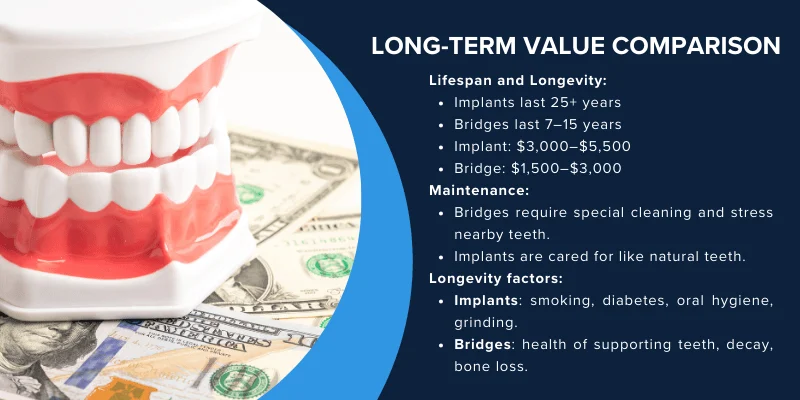
A dental implant typically lasts 25 years or longer, while bridges need replacement every 7 to 15 years. This difference in lifespan changes the total cost you’ll pay over time, even though implants cost more upfront.
Initial Cost Versus Lifetime Value
The upfront implant cost ranges from $3,000 to $5,500 for a single tooth, including the implant crown. A dental bridge costs between $1,500 and $3,000 initially, making it more budget-friendly at first.
Your dental insurance usually covers more of the bridge cost than implants. Many plans classify implants as cosmetic, which means lower coverage or none at all. This makes bridges look better for your budget in the short term.
However, the lifetime value tells a different story. If you’re 40 years old and get a bridge, you might need two or three replacements over your lifetime. That adds up to $4,500 to $9,000 total. An implant placed at the same age could last the rest of your life with just routine care.
Replacement Cycle and Maintenance Expenses
Bridge replacement becomes necessary when the dental crown supporting the bridge fails or the structure weakens. You’ll likely face this every 10 to 12 years on average.
Each bridge replacement means:
- New dental crown preparation on supporting teeth
- Additional filing of tooth structure
- Another $1,500 to $3,000 expense
- More time off work for appointments
Implants rarely need full replacement. The implant crown might need replacement after 15 to 20 years due to normal wear, costing $1,000 to $2,000. The titanium post itself usually lasts a lifetime.
Your maintenance costs differ too. Bridges need special floss threaders and extra cleaning time under the artificial tooth. Implants require regular brushing and flossing just like natural teeth.
Factors That Affect Longevity for Implants and Bridges
Implant failure happens in less than 5% of cases. Your habits play a big role in how long your implant lasts:
- Smoking reduces success rates significantly
- Uncontrolled diabetes affects healing and integration
- Poor oral hygiene leads to infection around the implant
- Teeth grinding can damage the implant crown
Bridge longevity depends on the health of your supporting teeth. Decay in these teeth means the entire bridge fails. Your supporting teeth carry extra chewing force, which can weaken them over time.
Bone loss affects bridges more than implants. The gap where your tooth was missing loses bone density without an implant to stimulate it. This can change your face shape and make future tooth replacement harder. Implants preserve bone by acting like natural tooth roots.
Jawbone Impact and Bone Health Considerations
When you lose a tooth, your jawbone doesn’t just stay the same. The bone needs stimulation from tooth roots to maintain its density and shape, which affects both your oral health and facial structure over time.
Bone Preservation: Why It Matters
Your jawbone stays strong when it gets regular stimulation from your teeth. When you chew, bite, or speak, the pressure travels through tooth roots into the bone. This activity tells your body to keep sending nutrients to that area.
Without this stimulation, your jawbone starts to shrink. This process can change the shape of your face over time, making you look older. Your remaining teeth may also shift into the empty space, causing bite problems.
A dental implant mimics a natural tooth by integrating with the jawbone, which keeps the bone active. A bridge doesn’t reach into the bone, so it can’t provide this benefit even though it fills the gap.
Osseointegration and the Role of the Jawbone
Osseointegration is the process where your jawbone fuses with a titanium implant post. This happens over several months after your dentist places the implant. The bone grows around the metal post and holds it firmly in place.
This fusion creates a stable foundation that acts like a natural tooth root. Your jawbone treats the implant as part of your body. The titanium post continues to stimulate bone growth every time you use it to chew or speak.
A dental bridge uses neighboring teeth as support instead of anchoring into your jawbone. While this restores your ability to chew, it doesn’t stop bone loss in the area where your tooth is missing.
Risks of Bone Loss with Missing Teeth
Bone resorption starts within the first year after you lose a tooth. Your jawbone can lose up to 25% of its width in this time. The bone loss continues at a slower rate for years afterward.
This affects more than just the empty socket. The bone loss can extend to neighboring teeth, weakening their support. Your facial muscles may also sag as the bone shrinks, creating wrinkles around your mouth.
Common effects of jawbone deterioration:
- Difficulty fitting dentures or bridges later
- Changes in your bite alignment
- Increased risk of losing more teeth
- Shifting of remaining teeth
Bone Grafting and Sinus Lift Scenarios
You might need a bone graft if you’ve already experienced significant bone loss. This procedure adds bone material to your jaw to create enough density for an implant. The graft material can come from your own body, a donor, or synthetic sources.
A sinus lift is a specific type of bone graft for your upper back teeth. Your sinuses sit close to your upper jaw, and bone loss in this area can make them drop down. The procedure raises the sinus floor and adds bone underneath to create space for an implant.
These procedures add time and cost to your treatment. Recovery from a bone graft typically takes three to six months before you can get an implant. However, they make implants possible even when you have poor bone density.
Don’t wait to address missing teeth and bone loss. Talk to Minot Dental Partners in Minot, ND, about your dental implant or bridge options with care tailored to you.
Effects on Adjacent Teeth and Oral Health
The way you replace a missing tooth directly affects the health of your surrounding teeth. Dental bridges require preparation of neighboring teeth, while implants stand alone without touching adjacent teeth.
Preparation Needed for Surrounding Teeth
When you choose a dental bridge, your dentist must reshape the two healthy teeth on either side of the gap. These abutment teeth need to be filed down to make room for the crowns that will support your bridge. This process removes healthy enamel that never grows back.
Your dentist typically removes about 60-75% of the tooth structure from these supporting teeth. Once this enamel is gone, those teeth become weaker and more sensitive. They will always need crowns to protect them, even if you later decide to switch to a different tooth replacement option.
Single tooth implants don’t rely on neighboring teeth for support because they’re anchored directly into your jawbone. Your adjacent teeth remain completely untouched and keep their natural structure.
Risk of Tooth Decay and Gum Disease
Dental bridges create areas where food particles and bacteria can get trapped between the false tooth and your gums. You need to clean under the bridge daily using special floss threaders or water flossers. If you don’t clean these areas properly, you risk developing tooth decay on your abutment teeth.
The crowns covering your supporting teeth can also trap plaque at the gum line. This increases your risk of gum disease around those teeth. Studies show that abutment teeth have a higher failure rate over time due to decay and gum problems.
Dental implants are easier to keep clean because you brush and floss them just like natural teeth. There’s no gap underneath where bacteria can hide. This makes it simpler to maintain good gum health around the implant.
Functional Impact on Chewing and Bite
Your chewing ability depends on how stable your tooth replacement is. Dental implants restore up to 90% of your natural chewing power because the titanium post fuses with your jawbone. This gives you a solid foundation that doesn’t shift when you bite down on tough foods.
Bridges restore about 60-70% of your normal chewing function. They can feel less stable because they depend on your abutment teeth for support. Over time, the cement holding the bridge can weaken, which may cause slight movement.
The stress from chewing also gets distributed differently. With a bridge, all the force transfers to your two supporting teeth. This extra pressure can wear them down faster. Implants distribute bite force directly into your jawbone, just like a natural tooth root would.
Daily Care and Maintenance Differences
Both implants and bridges need daily cleaning to stay healthy, but each uses different techniques. The tools you choose and how you use them can prevent common problems that lead to failure.
Cleaning Techniques for Implants and Bridges
Single tooth implants clean much like natural teeth. You brush twice daily with a soft-bristled toothbrush at a 45-degree angle to the gum line. The implant crown needs attention where it meets your gums because plaque builds up there quickly.
Bridges require extra steps because food gets trapped under the artificial tooth. You need to clean above, below, and around the entire bridge structure. The area underneath the fake tooth is hard to reach with a regular toothbrush alone.
Your bridge also connects to neighboring teeth with crowns. These connection points trap bacteria easily. You must clean these spots thoroughly every day to prevent decay in the supporting teeth.
Oral Hygiene Tools: Floss Threaders & Interdental Brushes
A floss threader helps you clean under bridges by threading floss beneath the artificial tooth. You loop regular floss through the threader, then guide it under the bridge to remove trapped food and plaque.

Interdental brushes are small cone-shaped brushes that clean between teeth and around bridge connections. They work well for reaching tight spaces that regular floss misses. Many people find them easier to use than floss threaders.
Water flossers spray pressurized water to clean around both implants and bridges. They flush out debris and bacteria from hard-to-reach areas. Water flossers work especially well for people who struggle with traditional flossing methods.
Implants typically need just regular floss or a water flosser. Bridges often require both floss threaders and interdental brushes for complete cleaning.
Common Causes of Implant and Bridge Failure
Poor oral hygiene causes most implant failures through a condition called peri-implantitis. This infection attacks the bone around your implant and can lead to implant loss. Skipping daily cleaning lets bacteria accumulate and trigger this problem.
Bridge failure happens when decay forms in the supporting teeth. The crowns that hold your bridge in place cover natural tooth structure that can still rot. Food trapped under the bridge feeds bacteria that cause this decay.
Gum disease weakens both implants and bridges. Inflamed gums pull away from teeth and implants, creating pockets where bacteria thrive. These infections destroy the bone that keeps your replacement tooth stable.
Not visiting your dentist regularly means problems go unnoticed until they become serious. Professional cleanings remove hardened plaque that you cannot eliminate at home. Your dentist also checks for early signs of failure during routine exams.
Who Is a Good Candidate and Key Decision Factors
Your eligibility for a single tooth implant or bridge depends on your bone health, overall medical condition, and personal goals. Understanding these factors helps you choose the option that fits your mouth and lifestyle best.
Dental Anatomy and Bone Density Requirements
Your jawbone must be strong enough to support an implant post. When you lose a tooth, the bone underneath begins to shrink over time because it no longer receives stimulation from the tooth root. Adequate bone density is essential for implant success since the titanium post needs to fuse with your jawbone.
Your dentist will evaluate your bone volume through X-rays or CT scans. If your bone has thinned, you may need a bone graft before implant placement, which adds time and cost to your treatment. People who are healthy enough for routine dental procedures like tooth extractions are usually good candidates for implants.
Bridges have more flexible requirements. They don’t rely on bone density since they use your adjacent teeth for support.
If you have multiple missing teeth or limited bone volume, an implant-supported bridge might combine the benefits of both approaches. Your facial structure and the position of neighboring teeth also matter when planning either restoration.
Medical History and Lifestyle Considerations
Your overall health affects which option works better for you. Conditions like uncontrolled diabetes, active gum disease, or heavy smoking can slow healing after implant surgery. Your immune system and medications also play a role in how well you recover.
If you take blood thinners or have had radiation therapy to your jaw, your dentist needs to review these factors carefully. Some patients prefer bridges because the procedure is less invasive and doesn’t require surgical healing time.
Your daily habits matter too. If you grind your teeth at night, you might need a nightguard to protect either restoration. Good oral hygiene is critical for both options but especially important for maintaining the gum tissue around implants.
Your timeline also influences your decision. Implants typically take several months from start to finish because of the healing period needed for osseointegration. Bridges can usually be completed in just a few weeks.
Aesthetic and Functional Expectations
Your priorities for appearance and chewing ability help determine which prosthetic tooth option suits you best. Implants look and feel more like natural teeth because each one stands alone without connecting to neighboring teeth. The custom crown sits at the gum line just like your original tooth did.
Bridges can also deliver natural-looking results when designed carefully. However, the connected units create a different appearance than individual teeth. Some patients notice the difference when flossing since you need to thread under the bridge instead of between separate teeth.
Your expectations for biting force matter too. Implants provide the strongest chewing function because they’re anchored directly in bone. Bridges rely on your adjacent teeth for support, which can feel slightly different when eating tough or sticky foods.
If you’re considering restorative dentistry options beyond a single tooth, the implant vs bridge question becomes more complex. An implant-supported bridge can replace several teeth without requiring individual implants for each missing tooth, which may reduce costs while still preserving bone.
Schedule a consultation with Minot Dental Partners to compare long-term costs, jawbone health, and maintenance for implants vs bridges.
Frequently Asked Questions
Dental implants typically cost more upfront but last 20-25 years or longer with minimal maintenance, while bridges have lower initial costs but need replacement every 8-12 years. Implants preserve jawbone density and protect neighboring teeth, whereas bridges can lead to bone loss and require grinding down healthy adjacent teeth.
What are the long-term costs associated with a single tooth implant compared to a dental bridge?
A single tooth implant usually costs between $3,000 and $6,000 initially. This might seem expensive at first. However, dental implants can last 20-25 years or even a lifetime with proper care.
Dental bridges typically cost $2,000 to $5,000 upfront, making them more affordable initially. But bridges generally last only 8-12 years before needing replacement.
Over a 20-year period, you might need to replace a bridge twice. This means paying for the procedure multiple times, plus additional maintenance costs. Implants often prove more cost-effective long-term because they rarely need replacement.
Your maintenance costs with implants remain low throughout their lifespan. You only need regular dental checkups and normal brushing habits. Bridges require more frequent professional care and potential repairs to supporting teeth.
How does a single tooth implant impact jawbone health over time?
Your jawbone needs stimulation to maintain its density and strength. When you lose a tooth, the bone beneath it starts to deteriorate because it no longer receives pressure from chewing.
A dental implant acts like a natural tooth root. The titanium post fuses with your jawbone through a process called osseointegration. This fusion provides the stimulation your bone needs to stay healthy and strong.
The implant prevents bone loss in the area where your tooth was missing. Your jawbone maintains its shape and density for decades. This preservation helps keep your facial structure intact and prevents the sunken appearance that can happen with tooth loss.
Without this stimulation, you can lose up to 25% of your jawbone width in the first year after tooth loss. An implant stops this deterioration completely by mimicking the function of a natural tooth root.
Can a dental bridge affect my remaining natural teeth in the long run?
Yes, a dental bridge requires grinding down the two teeth adjacent to your missing tooth. Your dentist must remove healthy enamel from these teeth to fit crowns that will support the bridge. Once this enamel is removed, it never grows back.
These supporting teeth become more vulnerable to decay and sensitivity after being reshaped. Food particles and bacteria can get trapped under the bridge, increasing your risk of cavities in the supporting teeth.
The bridge also places extra pressure on the adjacent teeth every time you chew. This additional stress can weaken these teeth over time. Some patients experience decay or damage to the supporting teeth that eventually requires additional dental work.
You might eventually lose one or both of the supporting teeth if they develop serious problems. This would mean replacing your three-unit bridge with a larger restoration or multiple implants.
Is there a difference in the lifespan of dental implants versus bridges?
Dental implants typically last 20-25 years or longer with proper care. Many implants last a lifetime because the titanium post becomes a permanent part of your jawbone. The crown on top might need replacement after 15-20 years due to normal wear.
Dental bridges usually last 8-12 years before requiring replacement. The lifespan depends heavily on how well you maintain them and the health of the supporting teeth.
Bridges fail more often because they rely on adjacent teeth for support. If those teeth develop decay or damage, the entire bridge needs replacement. The cement holding the bridge can also break down over time.
Implants have no such dependencies. They stand independently and don’t affect or rely on other teeth. The titanium post itself rarely fails once it has successfully fused with your bone.
What maintenance is required for a single tooth implant versus a dental bridge?
A dental implant requires the same care as your natural teeth. You brush twice daily, floss once a day, and visit your dentist for regular checkups. The implant crown can’t get cavities, but you still need to keep your gums healthy around it.
Cleaning a dental bridge takes more effort and special tools. You need to use floss threaders or interdental brushes to clean under the false tooth. Regular floss can’t reach these areas effectively.
Food particles easily get trapped under a bridge, especially near the gum line. If you don’t clean these areas thoroughly, bacteria can cause gum disease or decay in the supporting teeth. This requires extra time and attention during your daily oral care routine.
You’ll also need more frequent dental visits with a bridge to monitor the health of the supporting teeth. Your dentist needs to check for decay or damage that could compromise the entire restoration.
How do dental implants and bridges compare in terms of overall oral health benefits?
Dental implants preserve your jawbone density and prevent the bone loss that naturally occurs after tooth loss. This preservation maintains your facial structure and prevents the sunken appearance that can develop over time. Implants protect your natural teeth because they don’t require grinding down healthy adjacent teeth.
Your bite force remains strong with an implant. You can chew all types of food without worry. The implant distributes pressure evenly, just like a natural tooth would.
Bridges don’t stimulate the jawbone beneath the missing tooth area. This leads to gradual bone loss under the false tooth over time. The deterioration can eventually affect the stability of neighboring teeth.
A bridge requires permanent alteration of healthy teeth for support. These modified teeth face increased risk of decay and sensitivity throughout their lives. You’re essentially sacrificing two healthy teeth to replace one missing tooth.
Implants also make oral hygiene easier because you can clean around them like normal teeth. This simplicity helps you maintain better overall oral health compared to the complicated cleaning requirements of a bridge.