



If your dentist has told you that one wisdom tooth is fully erupted while another is impacted, you might wonder why your friend walked out of the same appointment with a simple extraction while you’re being scheduled for oral surgery.
The difference comes down to where the tooth sits, how much bone and gum cover it, and which angle it grew in at.
A fully erupted wisdom tooth has broken completely through the gum and can usually be removed the same way any other tooth is pulled.
An impacted tooth, on the other hand, is still partly or fully trapped under gum tissue, bone, or both.
That difference changes everything about the procedure, the recovery, and even whether removal is needed at all.
Wisdom teeth (also called third molars) don’t all follow the same growth pattern, so no two extractions look identical.
Some impacted teeth cause no symptoms for years, while a fully erupted tooth can still lead to infection if it’s hard to clean.
Getting a clear picture of impacted vs. erupted wisdom teeth helps you understand your own treatment plan instead of comparing it to someone else’s.
Key Takeaways
- Whether a wisdom tooth is erupted or impacted, and how deeply it’s impacted, determines the extraction method and recovery time.
- Symptoms like swelling, jaw pain, or bad breath can point to problems with either erupted or impacted teeth.
- Dental technology combined with hands-on exams actually decide whether your tooth needs removal or just monitoring.
How Fully Erupted and Impacted Teeth Differ
The core difference between an erupted and an impacted wisdom tooth is simple: one has broken through the gum in a normal position, and the other hasn’t.
Everything else, including how the tooth is removed and how long healing takes, branches off from that basic fact.
Every third molar starts below the gumline and moves upward as the jaw grows. When there’s enough room and the angle is right, the tooth erupts fully into place next to the adjacent teeth.
When there isn’t enough space, or the tooth is angled wrong, it can get stuck partway, becoming an impacted molar.
What Makes a Wisdom Tooth Fully Erupted?
A wisdom tooth is considered fully erupted once it has pushed completely through the gum tissue and lines up (reasonably well) with the teeth next to it.
You can see the whole crown, and it functions like any other molar for chewing.
Fully erupted wisdom teeth still need regular brushing and flossing since they sit so far back in the mouth.
But structurally, they’re not stuck in bone or tissue, which is a major factor in how they compare to impacted teeth.
What Does It Mean When a Wisdom Tooth Is Impacted?
An impacted tooth is one whose eruption has stalled, leaving it partly or fully trapped under gum tissue, jawbone, or both.
This happens most often with wisdom teeth simply because there’s rarely enough space at the back of the jaw for them to come in straight.
An impacted molar might be tilted toward the neighboring tooth, angled backward, or even lying sideways.
The angle matters almost as much as the depth, since a tooth leaning into the adjacent teeth can put pressure on their roots over time.
Soft-Tissue, Partial-Bony, and Complete-Bony Impactions
Impactions fall into three categories based on how much tissue covers the tooth:
- Soft-tissue impaction: The tooth has broken through the bone but is still covered by gum tissue.
- Partial-bony impaction: Part of the tooth remains buried in the jawbone itself.
- Complete-bony impaction: The tooth is entirely encased in bone, with none of the crown exposed.
As a general rule, soft-tissue impactions are typically less difficult to remove than bony ones, since less bone needs to be removed to reach the tooth.
Complete-bony impactions usually require the most extensive surgical work and the longest recovery window.
Symptoms and Risks That Need Dental Attention
Both erupted and impacted wisdom teeth can cause real problems, though the type of problem tends to differ.
Partially erupted teeth create small openings where bacteria can slip in, while fully erupted teeth are harder to keep clean simply because of their location at the very back of the mouth.

Why Partially Erupted Teeth Can Become Infected
A partially erupted wisdom tooth leaves a flap of gum tissue that traps food and bacteria, which often leads to infection.
This condition, called pericoronitis, causes gum irritation, an unpleasant taste, and sometimes a visibly swollen area around the tooth.
Left untreated, that gum infection can turn into recurring infections, bad breath that doesn’t go away with brushing, and jaw pain that spreads toward the ear.
Because impacted teeth trap more debris than erupted ones, they’re linked more often with cavities, gum disease, infection, crowding, and damage to nearby teeth.
Problems Even a Fully Erupted Wisdom Tooth Can Cause
A fully erupted wisdom tooth is not automatically a healthy one. Its position at the back of the jaw makes brushing and flossing harder, so tooth decay and gum disease can still develop even without impaction.
Crowding is another concern. An erupted wisdom tooth pressing against the neighboring molar can shift adjacent teeth out of alignment over months or years, which sometimes complicates orthodontic treatment.
When Swelling or Pain May Be Urgent
Certain symptoms point to an infection that needs prompt care rather than a wait-and-see approach.
Facial swelling, jaw stiffness, difficulty opening the mouth, swollen lymph nodes in the neck, or a fever alongside tooth pain are signs that bacteria may be spreading beyond the tooth itself.
Cyst formation is a less common but more serious risk tied to long-standing impacted teeth.
Cysts can slowly cause bone loss around the impacted tooth and even threaten nearby tooth roots, which is one reason dentists keep an eye on impacted teeth even without symptoms.
If you notice sudden swelling or worsening pain, it helps to know what counts as a dental emergency so you can decide how quickly to seek care.
How Dentists Decide Whether Removal Is Needed
Dentists rely on a hands-on exam paired with dental x-rays to determine whether a wisdom tooth should come out, stay monitored, or be referred for surgical evaluation.
Neither tool alone tells the full story. Together, they show the tooth’s position, angle, and relationship to nearby structures.
What a Dental Exam and X-Rays Can Reveal
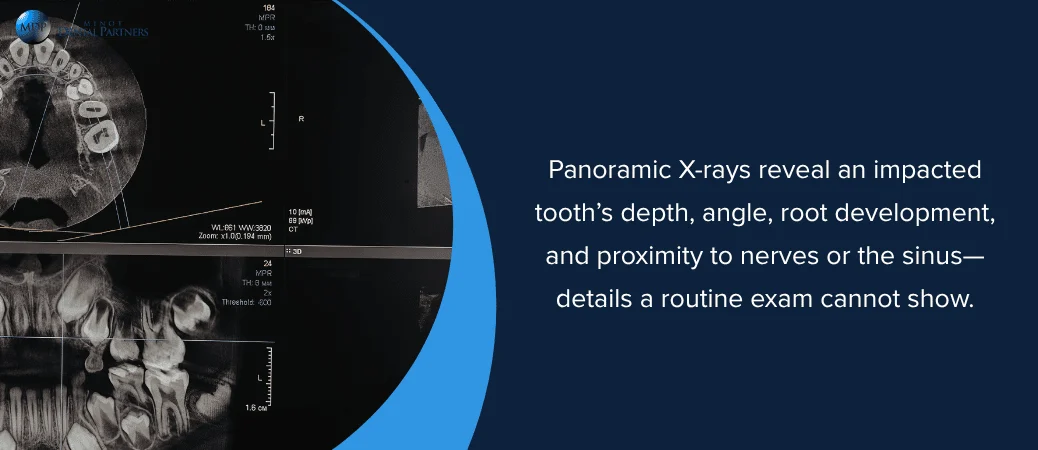
A dental checkup lets your dentist see how much of the tooth has broken through the gum and check for signs of infection or decay around it.
Panoramic x-rays go a step further, showing the tooth’s depth in the jawbone, its angle, and how close its roots sit to nerves or the sinus cavity.
This imaging is what separates a routine finding from one that needs closer attention. Two impacted teeth can look similar in the mouth but appear very different on an x-ray depending on how the roots have formed.
When Monitoring May Be Reasonable
Not every impacted tooth needs to come out right away.
If a tooth is impacted but shows no signs of infection, decay, or cyst formation, some dentists recommend periodic dental evaluation instead of immediate surgery, since research on asymptomatic impacted wisdom teeth hasn’t settled on one universal treatment approach for every case.
That said, monitoring works best with consistent dental care and regular imaging to catch changes early.
If you’re past your twenties and still have unremoved wisdom teeth, it’s worth reading about wisdom teeth removal after 30, since root development and bone density shift with age and can affect how monitoring decisions are made.
When Referral to an Oral Surgeon Makes Sense
Complex impactions, especially complete-bony ones or teeth positioned near a nerve, typically call for a referral to an oral surgeon.
Oral and maxillofacial surgeons have specialized training for extractions that involve significant bone removal or tooth sectioning.
How Tooth Position Changes the Extraction Plan
Tooth position is the single biggest factor separating a five-minute extraction from an hour-long surgical procedure.
Erupted teeth generally come out with straightforward technique, while impacted teeth, especially those angled sideways or buried in bone, require a more involved surgical approach.
Why Erupted Teeth May Be Removed With a Routine Extraction
A fully erupted wisdom tooth with a visible crown and normal root shape can often be removed the same way a dentist would pull any other problem tooth.
The dentist loosens the tooth with an elevator and lifts it out, without needing to cut gum tissue or remove bone.
Recovery from a routine extraction is usually shorter, with swelling and soreness settling down within a few days for most patients.
Why Bony Impactions Often Require Surgical Removal
Partial-bony and complete-bony impactions almost always need surgical removal, since the tooth is covered by gum tissue, bone, or both.
The surgeon may need to cut the gum, remove some bone, and section the tooth into pieces to take it out safely.
Angulation plays a big role here too. Disto-angular and horizontal impactions are linked with more swelling and reduced mouth opening after surgery compared with vertical or mesial-angled impactions, since these positions require more extensive surgical work to access the tooth.
Sedation, Surgical Planning, and Protection of Nearby Structures
More involved extractions often include sedation options to keep patients comfortable during longer procedures. This isn’t only about comfort.
Sedation also helps the surgeon work carefully around adjacent teeth, nerves, and the jawbone itself.
Surgical planning takes into account the tooth’s depth, its proximity to nerves, and how much bone will need to be removed.
This groundwork is part of why wisdom teeth removal is treated as its own category of care rather than a routine tooth extraction, particularly for complete-bony impactions where the margin for error is smaller.
Choosing Care Based on Your Tooth’s Position and Health

The right approach to your wisdom teeth depends on where they sit and how healthy they are right now, not on what worked for someone else.
Erupted wisdom teeth that are clean and well-aligned may need nothing more than good oral hygiene and regular dental evaluation.
Impacted wisdom teeth that show signs of infection, decay, or crowding usually call for removal, while quiet, symptom-free impactions may simply need watching.
| Erupted Wisdom Tooth | Impacted Wisdom Tooth | |
| Visible crown | Fully visible | Partly or fully hidden |
| Typical removal | Routine extraction | Surgical removal |
| Common risks | Decay, gum disease, crowding | Infection, cyst formation, bone loss |
| Recovery time | A few days | One to two weeks or more |
Getting a clear read on your own case starts with a dental exam and x-rays, not guesswork based on a friend’s experience.
Bringing your questions to a dental evaluation gives you a plan built around your actual anatomy, whether that means scheduling removal or simply keeping an eye on things at your next visit.
At Minot Dental Partners, Dr. Kyle Perkins can evaluate your wisdom teeth and review your x-rays with you, so decisions about monitoring or removal are based on the position and health of your own teeth.
Frequently Asked Questions
Are erupted wisdom teeth easier to remove?
Yes, in most cases. Since the tooth has already broken through the gum and sits in a normal position, it can often be removed with a routine extraction rather than surgical removal.
Are impacted wisdom teeth harder to remove?
Generally, yes, especially when bone covers part or all of the tooth. Complete-bony impactions and teeth with an awkward angle usually take longer to remove and involve more surgical steps than erupted teeth.
Do impacted wisdom teeth always need to be removed?
Not always. If an impacted tooth shows no signs of infection, decay, or cyst formation, some dentists recommend monitoring it with regular checkups and x-rays instead of immediate removal.
Is impacted wisdom tooth removal painful?
During the procedure, sedation and local anesthesia keep you comfortable.
Afterward, soreness and swelling are common for several days, and your dentist will typically prescribe pain management to help you through recovery.
How long does recovery take after removing a horizontally impacted wisdom tooth?
Recovery from a horizontally impacted wisdom tooth usually takes longer than from a routine extraction, often one to two weeks before swelling and discomfort fully resolve.
This angle requires more surgical work, which can extend the healing timeline.
What heals faster after wisdom tooth removal: upper or lower teeth?
Upper wisdom teeth generally heal faster than lower ones. Lower teeth tend to be impacted more often and sit in denser bone, which usually means more swelling and a longer recovery compared with upper extractions.