

Seeing your gums pulling back can feel scary, but it does not always mean you need surgery.
Not everyone needs gum grafting for receding gums, and stable, mild recession can often be watched over time instead of treated with surgery.
The real question is not whether you have some recession, but whether it is getting worse or causing problems.
Your dentist may have mentioned a gum graft, and now you are stuck wondering if it is truly needed or just a costly option.
You will learn how to tell the difference between a recession that needs watching and a recession that needs fixing.
You will also see when surgery makes sense, what it may cost, and what steps come before jumping into a procedure.
Your gums can reveal a lot about your overall dental health, so it helps to know what changes actually matter.
This guide walks you through how to spot real warning signs, how watchful waiting works, and what your options look like if a graft is the right call for you.
Key Takeaways
- You can often keep an eye on mild, symptom-free gum changes instead of rushing into surgery.
- Fixing the cause, like brushing too hard or gum disease, matters more than jumping straight to a fix.
- If you do need treatment, knowing your options and their costs helps you make a confident choice.
How to Tell Whether Recession Is Stable or Progressing
The best way to know if your gums need surgery or just some patience is to track a few clear signs over time.
Root exposure, gum and bone loss, and how your gums look between visits all give you clues about whether things are calm or getting worse.
What Root Exposure, Sensitivity, and Decay Risk Mean

When a gingival recession happens, part of your tooth root loses its cover of gum tissue. This is called root exposure, and it means the root is no longer protected the way it should be.
An exposed tooth root does not have enamel like the rest of your tooth. This makes it softer and more likely to wear down or get sensitive.
Tooth sensitivity, especially to cold drinks or brushing, is often the first sign something has changed. If root sensitivity shows up suddenly or gets worse fast, it may point to active recession rather than an old, stable spot.
Exposed roots are also more likely to develop root decay, since they lack the same protection as the crown of your tooth.
Watching for signs and stages of gum recession can help you catch these problems early.
Why Bone and Tissue Between Teeth Affect Prognosis
Recession does not just affect the gum you can see. It often connects to what is happening underneath, in the bone and tissue that hold your teeth in place.
Bone loss around a tooth can speed up recession and make the area harder to treat later. Tissue loss, meaning less firm, attached gum around the tooth, weakens its support even more.
If both bone and tissue loss are significant, the risk of tooth loss goes up over time. This is one reason dentists sometimes refer patients to a periodontist, a specialist in gum and bone health.
Periodontics focuses on exactly this kind of case, where the gum graft is compared with other options like bonding based on how much support remains around the tooth.
Signs That Call for a Prompt Dental Evaluation
Some signs mean you should not wait for your next regular checkup. Instead, you should call your dentist soon.
Get seen promptly if you notice any of these:
- Recession that has grown noticeably worse compared to older photos or notes
- Root exposure of 3 millimeters or more
- Sensitivity that keeps increasing instead of staying the same
- Visible root decay or a dark spot near the gumline
- Gums that bleed easily or look red and swollen
These patterns often mean the recession is active, not stable. Your dentist can compare current measurements to past ones to confirm if gum recession is actually getting worse or has simply plateaued.
When Monitoring Is a Reasonable Choice
Not every case of gum recession needs surgery right away. In many cases, your dentist may suggest a watch-and-wait approach if your gums are stable and you’re not dealing with pain or other problems.
Mild Recession Without Symptoms
If your recession is minor and you don’t have any pain, watchful waiting might be the best option. This is often true when there’s no sensitivity, no bleeding, and the area isn’t getting worse.
Your dentist will check your attached gum tissue to see if it’s healthy enough to protect the tooth root.
If your gum tissue is thick and firm, it can often hold up fine without a graft. But if you have thin gum tissue, your dentist may want to watch you more closely, since thin tissue tends to recede faster.
At Minot Dental Partners, a professional evaluation can help determine whether your gum tissue and bone support are healthy enough for monitoring or whether treatment should be considered.
How Dentists Track Changes Over Time
Your dentist can track small changes in your gums by measuring recession depth at each visit. This usually happens during your regular checkups or periodontal maintenance visits.
They may use a small ruler-like tool called a periodontal probe to check how far the gum has pulled back. They’ll also compare photos or notes from past visits to see if anything has changed.
If your numbers stay the same over time, that’s a good sign your gums are stable.
But if the recession keeps growing, even by a small amount, your dentist may bring up treatment options like a gum graft sooner rather than later.
Protecting Stable Gums From Further Damage
Even if your gums are stable, good dental care habits can help keep them that way. Small changes to your daily routine can make a big difference.
Here are a few simple steps your dentist may suggest:
- Switch to a soft-bristled toothbrush to avoid scrubbing your gums too hard
- Use gentle, circular brushing motions instead of side-to-side scrubbing
- Ask about fluoride varnish if your exposed roots feel sensitive
- Keep up with regular cleanings to catch changes early
- Avoid tobacco products, which can wear down gum tissue over time
Good oral hygiene treatment paired with these habits can help protect your gums from further recession, even without surgery.
Fix the Cause Before Choosing Surgery
A graft can add tissue back to your gums, but it will not fix the reason your gums receded in the first place.
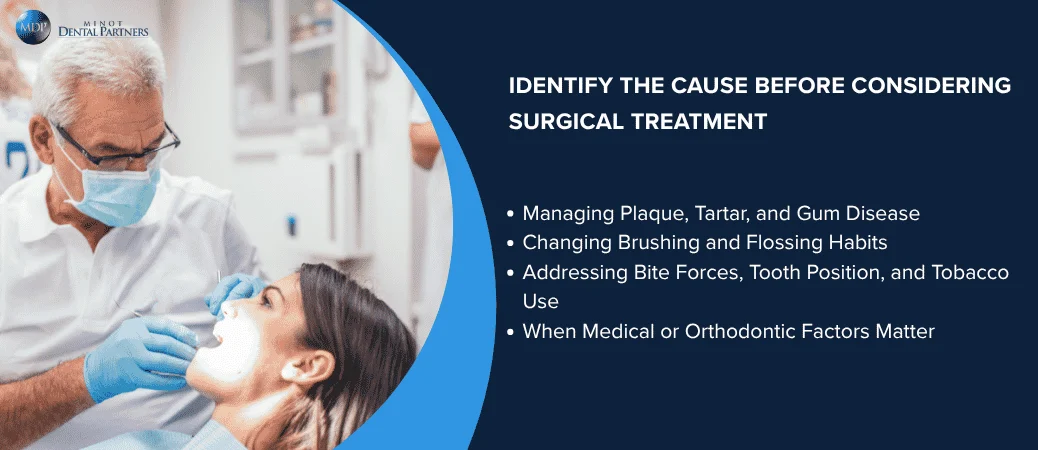
Before you agree to surgery, it helps to look at what is actually causing the problem, because treating that cause often stops the recession from getting worse.
Managing Plaque, Tartar, and Gum Disease
Plaque that sits on your teeth can turn into tartar. Tartar irritates your gums and can lead to gingivitis. If gingivitis is not treated, it can turn into gum disease, also called periodontal disease or periodontitis.
This infection breaks down the bone and gum tissue that hold your teeth in place. That breakdown is one of the main causes of the gum recession.
Your dentist may recommend a deep teeth cleaning. This removes plaque and tartar from below your gumline.
Your dentist might also suggest antimicrobial mouthwash or other antimicrobial treatments to help calm the infection. Treating the disease first gives any future graft a much better chance of success.
Changing Brushing and Flossing Habits
Brushing too hard is one of the most common reasons gums wear away. Hard bristles and heavy scrubbing can physically scrape away healthy gum tissue over time.
If this sounds like you, switch to a soft-bristled brush. Use light pressure and gentle circular motions instead of scrubbing back and forth.
Flossing matters too. Skipping it lets plaque build up between your teeth and along your gumline, which can make recession worse.
Learning the right brushing and flossing technique is one of the simplest gum recession treatment options available, and it costs nothing.
Addressing Bite Forces, Tooth Position, and Tobacco Use
Grinding your teeth puts extra force on your gums and the bone underneath. Over time, this can speed up recession. If you grind at night, a night guard can protect your teeth and reduce that pressure.
Misaligned teeth also play a role. When a tooth sits forward in your jaw, it often has thinner bone and gum tissue covering it, making that spot more likely to recede.
Comparing your tooth position treatment options with your dentist can help you decide if this needs attention.
Smoking and other tobacco use slow healing and raise your risk of gum disease, which can make recession worse.
When Medical or Orthodontic Factors Matter
Sometimes the cause is not something you can brush or floss away. If your teeth are crowded or crooked, orthodontic treatment such as braces may move them into a healthier position with thicker bone and gum support.
Certain health conditions matter too. Diabetes can slow healing and raise your risk of gum infections, so keeping it well managed helps your gums stay healthy.
Genetics also play a part. Some people are simply born with thinner gum tissue that recedes more easily, no matter how carefully they brush.
Hormonal changes, such as those during pregnancy, can make gums more sensitive and prone to irritation for a period of time.
Understanding these factors helps you and your dentist choose the right next step, whether that is a gum grafting procedure or simply a change in your daily care.
When Gum Grafting Is Worth Considering
Not every case of gum recession needs surgery, but some signs point clearly toward a graft.
If your recession keeps getting worse, exposes tooth roots, or puts your long-term dental health at risk, gum grafting may be the right choice for you.
Progressive Recession and Limited Attached Tissue
If your gums keep pulling back year after year, that’s a sign you probably need more than watching and waiting. This is especially true if you don’t have much attached gum tissue left to protect your teeth.
Attached tissue acts like a firm anchor around your tooth. When it wears too thin, your gums lose their ability to resist further recession.
A dentist can measure how much tissue you have left using a simple probe test. If you’re low on tissue and your recession is active, gum recession surgery can add tissue back and stop the problem from spreading to nearby teeth.
Waiting too long in these cases often means more tissue loss and a harder repair later.
Protecting Vulnerable Roots and Supporting Long-Term Tooth Health
When your roots are exposed, they don’t have the same protection as the crown of your tooth. This makes them more likely to decay, wear down, or feel sensitive to cold and heat.
A gum graft covers these exposed areas with healthy tissue. This protects your roots and can make daily brushing more comfortable, which supports better oral hygiene overall.
Your dentist might use a few different methods depending on your case:
- Connective tissue graft – tissue taken from under the surface of your palate, often called the gold standard for predictable results
- Free gingival graft – a thin layer of tissue taken directly from your palate’s surface
- Pedicle graft (also called a lateral graft) – tissue shifted from next to the affected tooth rather than from a separate site
Each option is chosen based on how much tissue you have and where your recession is worst.
Setting Realistic Root Coverage Goals
Gum grafting can restore a lot of lost tissue, but it doesn’t always cover 100% of an exposed root. Your outcome depends on things like the amount of recession, your tissue type, and the surgical technique used.
Talk with your dentist about what’s realistic for your specific case before moving forward. Some patients get full root coverage, while others see partial coverage that still meaningfully reduces sensitivity and protects the root.
It also helps to know that graft failure is uncommon but possible, especially if you smoke or don’t follow aftercare instructions closely.
Setting clear, realistic expectations upfront makes it easier to feel satisfied with your results, even if the outcome isn’t a complete fix.
Why a Periodontist Consultation Helps
A periodontist specializes in gum health and has the training to tell you whether grafting is truly your best option. They can check your tissue thickness, root exposure, and overall gum health to build a plan suited to you.
This step matters because not every recession case calls for the same periodontal treatment. Some patients only need better brushing habits or a deep cleaning, while others truly benefit from surgery.
Getting a second opinion, especially before committing to gum graft surgery, can help you feel confident that surgery is the right next step for your smile and long-term tooth health.
Comparing Surgical Options, Recovery, and Cost
If you need surgery, you have more choices than you might think, and each one has its own price tag, healing time, and recovery routine. Here’s what you need to know before you sit down with your periodontist.

Traditional Grafts and Donor Tissue Alternatives
The connective tissue graft is still the most common way to fix gum recession, and it works by taking a small piece of tissue from the roof of your mouth and stitching it over the exposed root.
If you don’t love the idea of a second surgical site in your mouth, ask your periodontist about an allograft. This uses donor tissue instead of your own, so you skip the extra cut on your palate.
Both options are usually done with sedation depending on your need, and some offices offer sedation if you feel nervous about the procedure.
Pinhole and Regenerative Procedures
The pinhole surgical technique is a newer option that doesn’t require any cutting or stitches.
Instead, your periodontist makes a tiny pinhole in the gum and gently loosens the tissue, then slides it down to cover the exposed root.
This approach tends to mean less swelling and a faster recovery than traditional grafting. For deeper cases where bone has also been lost, guided tissue regeneration may be a better fit.
This method uses a membrane along with a bone graft to help rebuild both gum and bone tissue.
In more advanced cases, your periodontist might recommend flap surgery, which involves temporarily lifting the gum tissue to clean and treat the roots and bone underneath before it’s stitched back into place.
What to Expect During and After Surgery
Most gum surgeries take place right in your periodontist’s office, and you’ll be numb from local anesthesia the entire time. If you’re anxious, sedation is often available too, so don’t be afraid to ask about it.
Post-operative care matters a lot for how well your graft takes and heals. You’ll likely need to avoid brushing the treated area for a couple of weeks, stick to soft foods, and skip straws since suction can loosen the graft.
Most people feel back to normal within a week or two, though full healing can take a few months.
Your periodontist will schedule follow-up visits to check on your progress and make sure everything is healing the way it should.
Financing Options and Out-of-Pocket Planning
Gum graft cost can vary depending on the technique used, the number of teeth being treated, and the complexity of the procedure.
Your dentist can provide a more accurate estimate after evaluating your gums and treatment needs.
If paying for treatment all at once is difficult, ask about available financing options or payment arrangements.
Financing may allow you to divide the total cost into more manageable monthly payments rather than delaying necessary care.
Keeping up with periodontal maintenance after surgery also helps protect your investment and lowers the odds you’ll need more work later.
Frequently Asked Questions
Here are quick answers to the questions people ask most about gum recession, grafting, and when surgery actually makes sense.
At what point does gum recession need surgery?
Surgery usually becomes the right call when recession keeps getting worse over time, not just because it looks noticeable.
Your dentist should compare current measurements to past records to see if the gum line has actually moved.
Other signs that point toward surgery include ongoing tooth sensitivity, a thin or worn-away band of gum tissue, or exposed roots that are at risk for decay. If none of these apply, monitoring the recession with photos and measurements is often a smarter first step than jumping straight to surgery.
How much gum recession is needed for a graft?
There is no exact measurement that automatically means you need a graft.
Instead, dentists look at the whole picture, including how much root is showing, whether you have enough healthy attached gum left, and whether the area is causing pain or sensitivity.
A mild recession that has stayed the same for months or years usually does not need grafting. But if you have very little or no attached gum tissue left, a graft can help protect the tooth even if the recession itself seems small.
Is a gum graft necessary, or can recession be monitored?
Not all recession needs surgery. If your gums have been stable, you have no symptoms, and you still have a healthy strip of attached gum tissue, watching and waiting is a reasonable plan.
A graft becomes more clearly necessary when the recession is documented as getting worse, when it threatens the bone around the tooth, or when brushing and daily habits alone cannot stop the problem.
Comparing your specific case against these treatment paths can help you understand which category you fall into.
Is gum grafting painful?
Most people feel some soreness after a gum graft, but it is usually manageable with over-the-counter pain relievers. The discomfort tends to peak in the first few days and then fade as the area heals.
If your own tissue is taken from the roof of your mouth, that donor site may feel a bit more tender than the graft site itself.
Following your dentist’s instructions on soft foods and gentle brushing helps keep healing on track and reduces discomfort.
How does gum graft surgery work?
During a gum graft, your dentist or periodontist adds tissue to the area where your gums have pulled back.
This tissue can come from your own palate, from a processed donor source, or from nearby gum tissue that gets shifted into place.
The new tissue is stitched over the exposed root to cover it and build up the gum line. Over the next few weeks, the graft heals and blends in with the surrounding gum tissue.
How much does gum graft surgery cost?
Costs depend on the type of graft, the number of teeth being treated, and the complexity of your case.
Your dentist can provide a personalized estimate after evaluating your gums and determining which grafting approach is appropriate.
If cost is a concern, ask about available financing options that may help make treatment expenses more manageable.