

Research frame
This guide focuses on adults and uses three linked constructs: dental anxiety/fear, care utilisation, and sedation dentistry supply-demand signals to compare dental anxiety statistics United States vs North Dakota.
CDC’s adult oral-health indicators define a dental visit as the share of adults aged 18+ who visited a dentist or dental clinic in the past year, and complete tooth loss as the share of adults aged 65+ who have lost all natural teeth due to decay or gum disease.
Those utilisation measures matter here because the recent literature consistently links higher dental anxiety with delayed or avoided care, worse oral-health-related quality of life, and more irregular attendance.
A central limitation is that I did not identify a recent, directly measured dental-anxiety prevalence estimate for North Dakota or Minot comparable to the national data.
For North Dakota and Minot, the strongest available evidence is therefore indirect: adult dental-visit rates, shortage-area data, local service availability, and provider marketing around anxiety reduction and sedation.
That makes the U.S. estimate firmer than the North Dakota and Minot estimates.

The national picture
Nationally, the main finding is that the answer depends on how anxiety is measured.
A 2021 systematic review and meta-analysis estimated adult dental fear/anxiety at 15.3%, high dental fear/anxiety at 12.4%, and severe dental fear/anxiety at 3.3%; the authors also found that prevalence shifts materially depending on the instrument used.
By contrast, a large 2025 U.S. survey reported that 72.6% of adults said they were afraid of going to the dentist. That is not incompatible with the meta-analysis: it reflects a broad “any fear” threshold rather than clinically high or severe anxiety.
The same U.S. survey found the most common feared elements were needles (39%), the drill (38%), and pain (37%). For research purposes, the best interpretation is that the addressable market for anxiety management is large, while the clinically high-anxiety segment is much smaller but still substantial.
The demand logic for sedation is straightforward. A 2024 systematic review found a strong association between dental anxiety, dental utilisation, and oral-health-related quality of life; the clinical literature also notes that conscious sedation is used primarily to manage anxious patients, along with those who have strong gag reflexes, special needs, or stress-sensitive comorbidities.
Common modalities are nitrous oxide/oxygen, oral benzodiazepine sedation, and IV sedation.
Utilisation data show why that matters commercially. In 2024 BRFSS, 67.5% of U.S. adults reported a dental visit in the past year.
Earlier NHIS data also show a pandemic-era utilisation dip, with adult visits falling from 65.5% in 2019 to 62.7% in 2020, and lower visit rates in less urban areas. CDC’s rural-access review similarly reports that adults aged 18–64 in rural America have about 10% less access to dental services than urban counterparts.
North Dakota and Minot

North Dakota looks slightly better than the U.S. average on basic adult utilisation, but not on structural access. In 2024 BRFSS, North Dakota’s adult dental-visit rate was 68.4%, just above the U.S. rate of 67.5%.
However, HRSA reported that as of 30 June 2026, North Dakota had 71 dental Health Professional Shortage Area designations, with 119,626 people living in designated dental HPSAs; only 29.61% of need was met, and 16 additional practitioners were needed to remove the designations.
That means state-level demand may be reasonably healthy even while supply remains constrained.
For Minot, the best public geographic comparator is still Ward County, because recent city-level anxiety data were not identifiable.
The latest official county oral-health figure I could verify is older: in the 2013–2017 Ward County Community Profile, 36.9% of adults reported not having had a dental visit in the prior year, versus 34.2% statewide in the same period.
That implies a Ward County dental-visit rate of roughly 63.1%, slightly below the North Dakota figure for that period. It is not a 2026 figure, but it is a useful local baseline suggesting a modest utilisation gap.
Demographically, Minot is somewhat younger than both North Dakota and the United States, which moderates one of the biggest national demand drivers.
The share of residents aged 65+ is 18.9% in the U.S., 17.9% in North Dakota, 15.6% in Ward County, and 14.3% in Minot.
Population estimates for 2025 are 799,358 for North Dakota, 68,233 for Ward County, and 48,387 for Minot.
This younger profile suggests Minot may see slightly less age-driven sedation demand than the U.S. average, but that does not eliminate the need created by fear, complex restorative work, surgery, or the city’s role as a regional service hub.
Sedation dentistry demand and supply signals

The clearest Minot-specific signal is not a survey but the visible breadth of sedation and anxiety-reduction offerings.
Trinity Health’s 2025 Community Health Needs Assessment lists 23 dental service sites/listings in Minot, including general practices, speciality offices, community-health sites, and oral surgery.
Within that local market, multiple practices currently advertise anxiety-management or sedation services.
The strongest directly verifiable examples are these. Minot Dental Partners markets both general sedation dentistry and IV sedation, stating that sedation is used for anxious patients and that IV sedation is intended for severe dental anxiety.
Lengthy procedures and complex surgical or reconstructive work, with a CRNA administering and monitoring IV sedation.
Souris Valley Dental Group offers nitrous oxide and presents sedation as suitable for mild, moderate, or severe anxiety, traumatic past experiences, gag reflex problems, and fear of needles.
Dakota Square Dental advertises oral conscious sedation for patients with high anxiety. Dakota Dental Health Center offers nitrous oxide and conscious oral sedation.
Broadway Family Dentistry markets NuCalm specifically to reduce dental anxiety, and West Hills Dental advertises nitrous oxide.
For a city of roughly 48,000 residents, that is a meaningful concentration of anxiety-focused service lines.
North Dakota regulation also shapes supply. Under the state administrative code, dentists in North Dakota may not provide sedation beyond minimal sedation without a board permit.
For moderate sedation, the state requires a permit, substantial formal training, live-patient clinical experience, life-support certification, and a site evaluation; separate rules apply for deep sedation and general anaesthesia.
In practical terms, this raises compliance costs and likely keeps the number of moderate/deep-sedation providers lower than the number of general dentists.
That tends to support steady pricing power and referral demand for credentialed providers.
A concise comparison is below.
Outlook beyond 2026
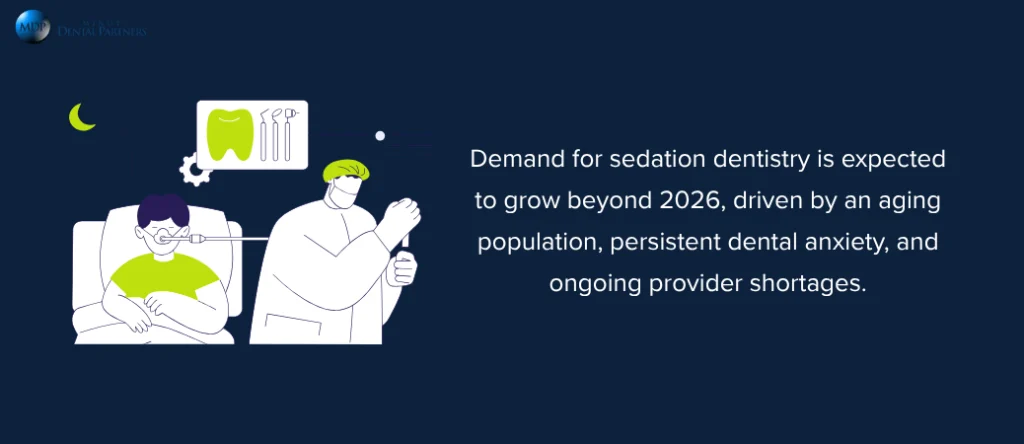
The most likely post-2026 direction is continued growth in demand for anxiety-management and sedation-enabled care, especially for adults who have delayed treatment and then present with larger, more invasive treatment plans.
Nationally, the population aged 65+ reached 61.2 million in 2024 after growing 3.1% in a single year, and Census has long projected that by 2030 all baby boomers will be 65 or older and 1 in 5 U.S. residents will be of retirement age.
Older adults are more likely to need complex restorative, surgical, and medically coordinated care, even though Minot itself is somewhat younger than the national average.
Workforce growth does not look fast enough to eliminate access pressure. BLS projects dentist employment to grow only 4% from 2024 to 2034, while dental hygienists are projected to grow 7% over the same period.
That is positive, but not explosive, and it sits alongside HRSA’s 2026 evidence of continuing dental shortage designations in North Dakota.
In other words, even if baseline general dentistry capacity rises, there is little evidence that sedation-capable capacity will expand so quickly that demand pressure disappears.
For Minot specifically, the most defensible forecast is this: demand for sedation dentistry should remain at least stable and probably strengthen modestly beyond 2026, driven less by ageing alone than by four factors acting together—persistent dental anxiety, regional catchment demand from surrounding communities, shortage pressure across North Dakota, and the operational value of sedation for consolidating extensive treatment into fewer visits.
The visible number of Minot practices already competing on “comfortable”, “anxiety-free”, “nitrous”, “oral sedation”, or “IV sedation” strongly suggests that providers themselves see this as a durable service line rather than a niche extra.
Open questions and limitations
The biggest evidence gap is the absence of a recent, directly measured North Dakota or Minot prevalence estimate for dental anxiety using a standard instrument such as the MDAS.
That means local conclusions rely on a mix of older official utilisation data, current shortage data, demographics, and provider-side service visibility rather than a clean local anxiety survey.
For a follow-on study aimed at publication or commercial planning, the highest-value additions would be: a claims-based estimate of nitrous/oral/IV sedation use in North Dakota; provider counts by sedation permit type; and a local Minot/Ward County survey using the same anxiety instrument as the national literature.
Without those, the national finding is precise, but the North Dakota and Minot conclusions should be treated as well-supported demand inferences, not definitive local prevalence estimates.
References
[1] Adult Indicators | Oral Health Data Systems
[2] [6] [7] Explore Dental Visit in North Dakota | AHR
[3] Review article Estimated prevalence of dental fear in adults
[4] Dental Fear is Widespread—But Most People Want …
[5] Relationship Between Dental Anxiety, Dental Utilization,…
[9] U.S. Census Bureau QuickFacts: United States
[10] trinityhealth.org
[11] [15] Sedation Dentistry Minot, ND | Comfortable, Anxiety-Free Care
[12] [14] Chapter 20-02-01 General Requirements
[13] Conscious Sedation in Dentistry – StatPearls – NCBI Bookshelf
[16] Older Adults Outnumber Children in 11 States and Nearly …
[17] Dentists : Occupational Outlook Handbook
[18] BCD_HPSA_SCR50_Qtr_Smry