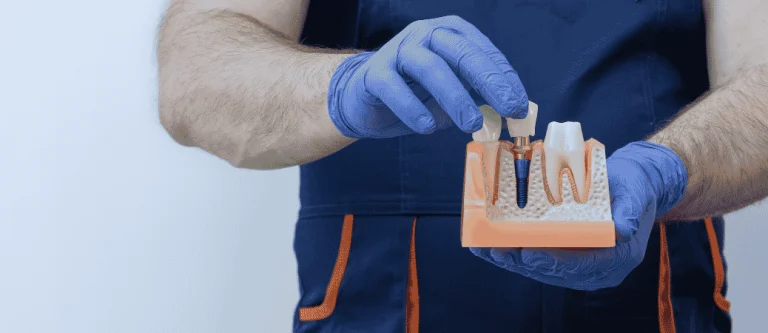
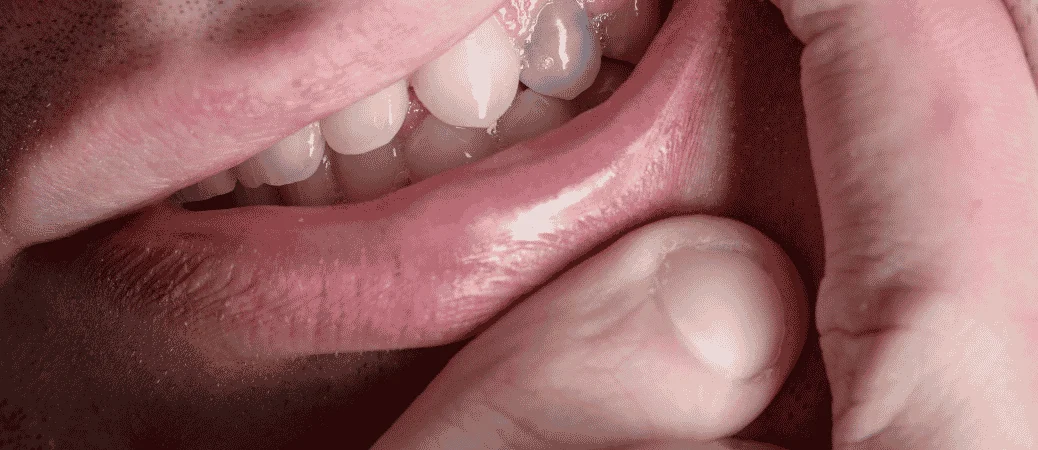
Noticing a dark tooth after a root canal can be unsettling, especially when it doesn’t hurt at all. You brush, you floss, and nothing feels wrong, yet the tooth’s color has changed.
This may happen because of internal staining or older dental materials, but a dental examination is important to rule out decay or infection.
A tooth that turns dark after root canal treatment has not necessarily developed another problem.
However, a dental examination can help determine whether the discoloration is cosmetic or related to decay, infection, or an existing restoration.
Discoloration by itself is often a cosmetic sign that the tooth no longer has living tissue inside it.
That said, only an exam and an X-ray can rule out the quieter problems, like a slow infection, that don’t always announce themselves with pain.
This matters because a tooth can look fine on the outside while something changes underneath it. Having the tooth examined can help identify whether the color change is cosmetic or related to a problem that needs treatment.
Key Takeaways
- A dark root canal tooth without pain is often cosmetic, but it still deserves a dental check to confirm there’s no hidden infection.
- Internal staining, old filling materials, past trauma, and decay can all darken a tooth, and only an exam tells them apart.
- Treatment options range from internal bleaching to a crown or veneer, depending on how much healthy tooth structure remains.
Does a Painless Dark Tooth Need a Dental Visit?
Yes, a painless dark tooth still needs to be looked at, even though the lack of pain is a genuinely good sign.
A dark tooth or a tooth turning black doesn’t automatically mean trouble, but it does mean your dentist should confirm what’s happening inside it.
Think of it like a quiet warning light on a dashboard. It’s not screaming at you, but it’s worth a look before you ignore it for another year.
When Is a Routine Appointment Enough?
A routine checkup is enough when the discoloration is gradual, you have no new symptoms, and you’ve been keeping up with your usual dental visits.
If the color change has crept in slowly over months or years with nothing else different, mentioning it at your next scheduled cleaning is a reasonable approach.
Your dentist can take a look, compare it to prior records, and decide whether an X-ray is needed right then.
Which Symptoms Call for Prompt Care?
Prompt care is needed when the dark tooth comes with any new symptom, not just a cosmetic change. Call your dentist sooner rather than later if you notice:
- Pain when biting or chewing
- Swelling in the gum or face
- A small bump on the gum near the tooth
- A bad taste or drainage
- Sensitivity that lingers
These symptoms may indicate infection or another dental problem rather than simple staining. Contact your dentist promptly, and seek emergency dental care if you develop significant facial swelling, severe pain, or other urgent symptoms.
Why Does a Root Canal Tooth Change Color?
A tooth may darken after root canal treatment because of pigments left by damaged or bleeding pulp tissue, certain dental materials, or changes within the tooth’s dentin.
Discoloration does not happen to every root canal-treated tooth, and losing the pulp’s blood supply alone does not explain every color change.
Several things can contribute to tooth discoloration beyond the loss of blood flow alone.
Residual tissue breakdown, old sealing materials, and the natural aging of dentin all play a role, and not every treated tooth darkens in the same way or at the same pace.
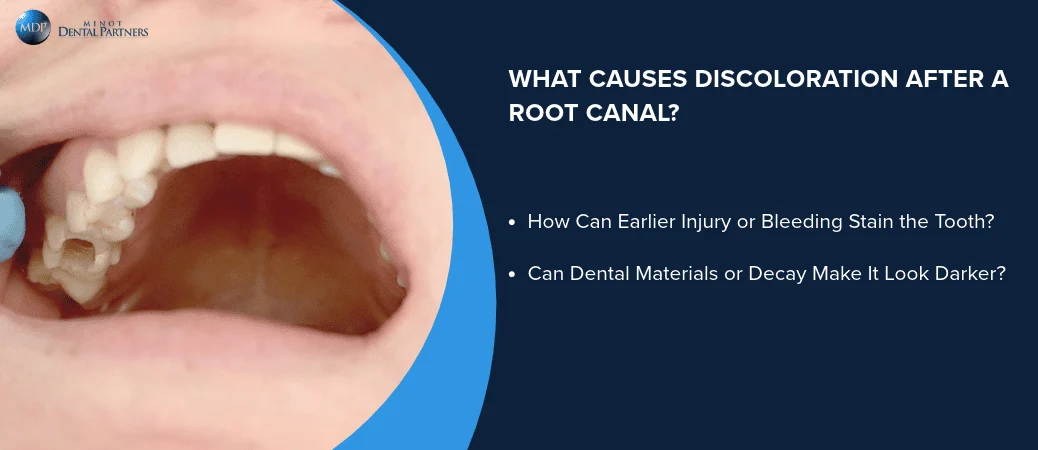
How Can Earlier Injury or Bleeding Stain the Tooth?
Internal bleeding from an injury before the root canal was even done can leave a lasting stain. If the tooth was knocked or cracked at some point, small amounts of blood can seep into the dentinal tubules, the tiny channels running through the dentin.
Over time those blood pigments break down and darken, sometimes showing up as a gray or brownish tint years after the original injury.
Can Dental Materials or Decay Make It Look Darker?
Yes, both older dental materials and new decay can darken a tooth, and a dentist needs to tell them apart.
Some materials used in root canals or restorations decades ago, including silver amalgam fillings, can leach into the tooth and cause grayish staining.
Amalgam fillings placed near the pulp chamber are a common culprit for this kind of discoloration.
Separately, tooth decay forming under or around an old filling can create its own dark shadow, which looks similar but needs very different treatment.
How Will a Dentist Check Whether the Tooth Is Healthy?
A dentist checks a dark tooth with a visual exam, a bite and percussion test, and an X-ray to see what’s happening below the surface.
These steps help separate harmless internal staining from a problem that needs treatment, since the two can look nearly identical to the naked eye.
Your dentist may gently tap the tooth, check for tenderness when biting, examine the surrounding gums, and compare X-rays with earlier images.
Because the pulp has already been removed, routine pulp sensitivity tests cannot assess the treated tooth in the same way as a tooth with living pulp.
What Can an Exam and X-Ray Reveal?
An X-ray can help your dentist assess the appearance and extent of the root canal filling, look for changes in the surrounding bone, and identify possible signs of infection.
However, an X-ray cannot confirm that every part of the root canal system is completely sealed.
During dental exams and check-ups, your dentist can assess the tooth’s appearance, surrounding gums, and existing restorations.
This examination may reveal swelling, drainage, or other changes that X-rays alone cannot identify.
Could a Crown, Filling, or Crack Be Involved?
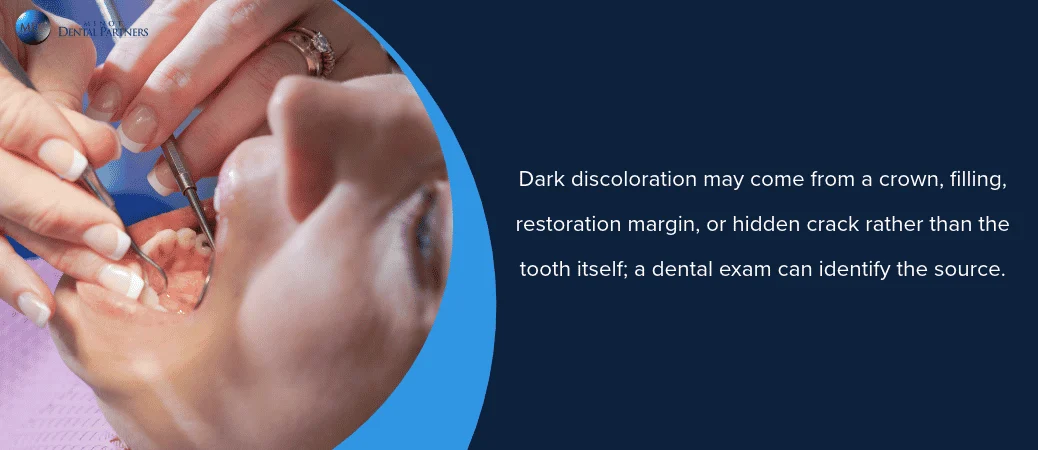
Yes, a dentist will also check whether an existing dental crown, filling, or a hidden crack is contributing to the dark appearance.
Sometimes what looks like internal staining is actually a restoration margin that has darkened, or a microscopic crack letting in stain from food and drinks.
If you notice a dark tooth is sitting under its crown rather than next to it, that’s a detail worth mentioning, since it changes what the dentist looks for first.
If you notice a visible color change around a crown or filling, bring it up during your dental examination.
Your dentist can assess whether the discoloration comes from the restoration, the underlying tooth, or another problem that needs attention.
What Can Restore the Tooth’s Appearance?
Several options exist to restore a darkened tooth’s appearance, and the right one depends on how much healthy structure is left.
The main choices are internal bleaching, bonding, veneers, and crowns, each suited to a different level of discoloration and tooth strength.
When Is Internal Bleaching an Option?
Internal bleaching works best when the tooth is structurally sound and the discoloration comes from inside the dentin itself.
A dentist places a whitening agent, such as hydrogen peroxide, carbamide peroxide, or sodium perborate, inside the tooth through a small opening and seals it between visits.
This approach is described by the American Dental Association as treating intrinsic staining from the inside out, and it tends to be less invasive than covering the tooth with a crown when the tooth is mostly intact.
One rare but recognized risk is external cervical resorption, where the outer root structure near the gumline starts to break down, so your dentist will explain what signs to watch for afterward.
When Are Bonding, Veneers, or a Crown Better Choices?
When internal bleaching is unsuitable or cannot achieve the desired appearance, your dentist may consider other restorative options.
Dental bonding can help improve mild discoloration or small cosmetic imperfections, although darker internal stains may be difficult to conceal.
Porcelain veneers can cover the front surface of suitable teeth and provide a more uniform appearance.
When substantial tooth structure is missing or additional protection is needed, dental crowns may help restore function and appearance. The best option depends on the tooth’s remaining structure, position, and overall condition.
How Can You Care for the Tooth While You Wait?
Caring for a darkened root canal tooth while you wait for your appointment mostly means protecting it from further damage and watching for change.
Keep up your normal oral hygiene routine of brushing twice daily and cleaning between teeth, since root-treated teeth can still develop decay around their edges.
Protecting the Restoration and Watching for New Symptoms
Avoid biting hard objects such as ice, especially if the treated tooth has a large filling, weakened structure, or a temporary restoration.
Root canal-treated teeth may be more vulnerable to fracture because of previous decay, damage, and loss of tooth structure, rather than simply because the pulp’s blood supply has been removed.
Keep your scheduled dental checkups, since routine exams let your dentist track whether the color is stable or changing and compare new X-rays against older ones.
Write down the date you first noticed the color change, since that detail helps your dentist judge how quickly things are progressing.
If new symptoms appear, such as swelling, drainage, or pain when biting, call your dentist before your next scheduled visit rather than waiting it out.
A Painless Color Change Still Deserves a Check
A root canal tooth that’s turned dark but doesn’t hurt is usually a cosmetic change, not a sign of failure. Still, the only way to know for certain is a short dental exam with an X-ray.
Internal staining, old filling materials, past trauma, and new decay can all look similar from the outside, and separating them takes a trained eye.
Once your dentist confirms the tooth is healthy, you can choose a cosmetic fix, whether that’s internal bleaching, bonding, a veneer, or a crown, based on what will actually work for that tooth.
If you notice a dark tooth after a root canal, Dr. Kyle Perkins at Minot Dental Partners can evaluate the tooth and discuss whether the discoloration needs treatment or continued monitoring.
Frequently Asked Questions
Can a root canal tooth turn black years later?
Yes, a root canal tooth can darken years after treatment, since internal changes to the dentin happen slowly over time.
Staining from blood pigments, old filling materials, or structural changes in the tooth can take years to become visible through the enamel.
How long does it take for a root canal tooth to turn gray?
There’s no set timeline, since some teeth darken within months while others take years or never change much at all.
The speed depends on factors like the cause of the original damage, the materials used during treatment, and the individual tooth’s structure.
Can a root canal tooth get infected without hurting?
Yes, a root canal tooth can become reinfected without causing pain, which is why X-rays matter even when nothing hurts. A slow-growing infection at the root tip can show up on an X-ray as a dark area long before it causes any discomfort.
Why does my root canal tooth look black under its crown?
A tooth can look dark near the gumline under a crown if the underlying tooth structure has stained or if the crown’s margin has shifted or worn.
This is worth pointing out at your next visit, since your dentist can check whether it’s a cosmetic issue or a sign the crown needs attention.
Will regular whitening fix discoloration after a root canal?
External whitening may improve some surface or tooth discoloration, but it may not adequately treat deep internal staining after root canal treatment.
For suitable teeth, a dentist may recommend internal bleaching. Bonding, veneers, or crowns may also be considered depending on the tooth’s condition and the cause of discoloration.