Executive findings
Recent statistics on dental emergency room visits show different trends across the United States and North Dakota.
The latest dedicated CDC analysis reported an annual average of 1.944 million emergency department (ED) visits for tooth disorders during 2020–2022, equivalent to 59.4 visits per 10,000 people.
That represented a statistically significant decline from 88.4 per 10,000 in 2014–2016 and 69.8 in 2017–2019.
In North Dakota, however, the state’s more recent ESSENCE surveillance series shows increasing tooth-pain ED activity: 2,874 events in 2021, 3,165 in 2022, 3,717 in 2023 and 4,715 in 2024.
Thus, the recorded number increased by approximately 64% between 2021 and 2024, including a roughly 27% increase from 2023 to 2024.
The same series shows 2,625 events in 2020, meaning the 2024 count was almost 80% above its 2020 level.
For Minot, no reliable city-specific annual dental-ED count or population-adjusted rate was identified in the public datasets reviewed.
The strongest local evidence is for Ward County: a peer-reviewed North Dakota study identified Ward as one of four counties selected from those with the highest per-capita rates of ED visits for non-traumatic dental conditions during the combined 2018–2021 period.
Minot contained an estimated 47,308 residents in 2025, compared with 68,233 for Ward County (about 69% of the county population) so Ward County evidence is highly relevant to Minot, but it cannot legitimately be converted into a Minot-specific ED rate.
| Geography | Best recent public indicator | Finding | Interpretation |
| United States | CDC NHAMCS, tooth disorders, 2020–2022 | 1.944 million visits/year; 59.4 per 10,000 | Long-term national rate declined through 2022. |
| North Dakota | ESSENCE tooth-pain ED events, 2021–2024 | 2,874 → 4,715 | Approximately 64% growth during 2021–2024. |
| Minot | Ward County NTDC evidence | Ward selected among four high-use counties | Indicates substantial local relevance, but no defensible city-specific rate is publicly available. |
The comparison therefore supports a cautious conclusion: national dental ED use has fallen over the longer term, while North Dakota has experienced a marked post-pandemic increase, and the available evidence places the Minot/Ward County area among locations where non-traumatic dental ED utilization warrants particular attention.
The datasets are not sufficiently harmonized to conclude exactly how much higher or lower Minot or North Dakota is than the national rate.
Understanding what the statistics actually measure
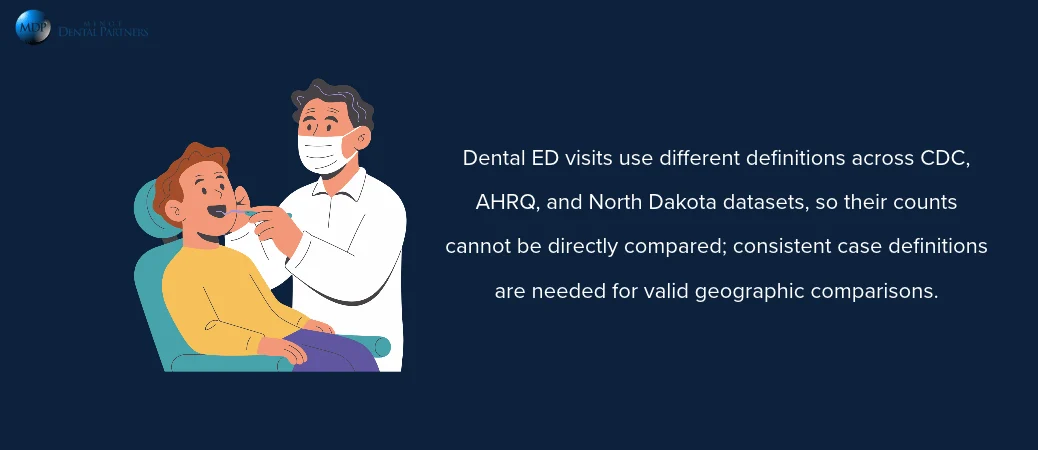
“Dental emergency room visit” is not a single standardized surveillance measure. This matters greatly when comparing the U.S., North Dakota and Minot.
The CDC’s national estimate classifies a visit as involving a tooth disorder when a tooth-related reason for visit or qualifying diagnosis is recorded.
Its 2020–2022 estimate includes a defined group of ICD-10-CM diagnoses as well as tooth-related reasons for visit.
AHRQ uses another approach: its Healthcare Cost and Utilization Project counts treat-and-release ED visits where dental conditions are the first-listed diagnosis, and separates traumatic from non-traumatic dental conditions. In 2020, AHRQ estimated 2.572 million such visits, of which 1.487 million were non-traumatic.
North Dakota ESSENCE likewise has multiple analytic definitions. A 2024 peer-reviewed study using specified ICD codes for non-traumatic dental conditions (NTDCs) reported 1,967 North Dakota visits in 2021.
By contrast, the newer state presentation reports 2,874 “tooth pain events” in 2021. These are differently defined surveillance extracts and should not be combined into one time series or used for direct U.S.-versus-North-Dakota rate ratios.
For research purposes, the most defensible approach is therefore to compare direction, patient characteristics and access-related patterns, while reserving direct numerical rate comparisons for future analyses using an identical dental case definition across geographies.
United States: national burden and patient profile
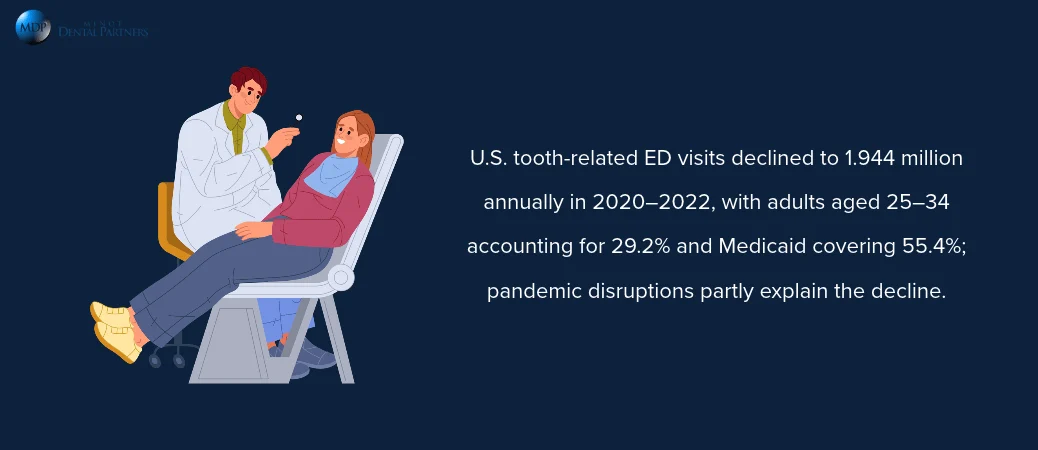
The CDC’s June 2025 report remains the latest dedicated national NCHS publication on tooth-disorder ED visits listed by CDC. It estimated 1,944,000 visits annually during 2020–2022, or 59.4 per 10,000 population.
The corresponding estimates were 2.794 million annually in 2014–2016 and 2.247 million in 2017–2019, confirming a substantial downward trend before and through the pandemic period.
The national burden is concentrated among younger working-age adults.
People aged 25–34 generated 29.2% of tooth-disorder ED visits, the largest share of any age category, followed by those aged 35–44 at 20.2%. Adults aged 65 and over accounted for only 6.9%.
Insurance status strongly distinguishes this patient population. During 2020–2022, Medicaid was the expected primary payer for 55.4% of tooth-related ED visits, compared with 19.3% for private insurance, 12.2% uninsured and 10.4% Medicare.
This pattern is important because dental ED utilization is closely intertwined with affordability and access to definitive outpatient dental care.
AHRQ’s complementary data illustrate the scale and cost of the problem. Treat-and-release dental ED visits fell from 3.126 million in 2019 to 2.572 million in 2020, a 17.7% reduction during the first pandemic year.
Non-traumatic visits fell 23.1%, from 1.933 million to 1.487 million, yet total hospital costs for dental treat-and-release visits remained approximately $1.1 billion in both years.
This pandemic disruption is important when interpreting the national decline: the lower 2020 utilization partly reflected extraordinary disruption to healthcare-seeking rather than necessarily an equivalent reduction in untreated dental disease.
North Dakota: a clear recent increase
North Dakota’s newer surveillance data present a substantially different post-2020 pattern. ESSENCE-recorded tooth-pain ED events rose as follows: 2,625 in 2020; 2,874 in 2021; 3,165 in 2022; 3,717 in 2023; and 4,715 in 2024.
There was therefore no annual decline in this series after 2020; instead, the increase accelerated toward 2024.
Earlier peer-reviewed analysis helps identify who is affected. Using a narrower NTDC definition, Schroeder and colleagues found that adults aged 25–34 represented the largest group of North Dakota NTDC emergency department users, accounting for 33% of the ESSENCE sample in 2021. Adults aged 35–44 accounted for 23%.
This age distribution closely resembles the national CDC findings, where adults aged 25–34 also represented the largest share of tooth-related emergency department visits.
The North Dakota research also found substantial disparities in combined 2018–2021 data: reported NTDC ED rates were 2,402 per 100,000 for Black residents and 1,937 per 100,000 for American Indian/Alaska Native residents, versus 621 per 100,000 among White residents.
These are study-specific combined-year estimates rather than annual CDC-comparable rates, but they identify important populations for state-level prevention research.
Access barriers emerged repeatedly in interviews with North Dakota emergency and dental professionals.
Respondents cited a lack of a regular dental home, inadequate insurance, difficulty finding providers accepting Medicaid and concerns among dental practices about reimbursement and administrative burden.
Providers generally did not regard patients experiencing significant pain or infection as improperly using the ED; rather, they viewed much of the underlying need as potentially preventable through earlier and more equitable dental care.
A particularly relevant policy issue remains unresolved in 2026. North Dakota HHS states that the state’s Medicaid Expansion program for adults aged 19–64 does not provide dental or vision care, even though some other traditional Medicaid eligibility categories include dental benefits.
North Dakota’s 2025–2026 Interim Health Care Committee is consequently examining unmet dental needs, Medicaid reimbursement, provider participation, workforce problems, rural access, telehealth and the potential effects of adding dental coverage to Medicaid Expansion.
Minot and Ward County: what can and cannot be concluded
The most important local research finding is that Ward County was one of four North Dakota counties, along with Cass, Stutsman, and Williams, selected as high-use locations in the peer-reviewed study of non-traumatic dental conditions.
The selection came from an ESSENCE county heat map based on per-capita NTDC emergency department utilization during 2018–2021.
That makes Ward County a meaningful proxy for understanding the Minot area’s problem, particularly because Census estimates put Minot’s 2025 population at 47,308 compared with 68,233 countywide.
It does not, however, mean that roughly 69% of Ward County dental ED visits necessarily occurred among Minot residents.
Hospital catchment areas, patient mobility, rural referrals and geographic differences in access prevent such an assumption.
No Minot-specific annual dental ED numerator was found in the public state surveillance material, peer-reviewed North Dakota study or federal sources reviewed for this report.
Consequently, statements such as “Minot has X dental ER visits per 100,000 residents” would presently require hospital-level or ESSENCE data that have not been publicly reported in a form that supports that calculation.
The local clinical implication is that patients often need definitive dental treatment after receiving emergency department care for dental pain or infection.
Access to timely emergency dental care can help patients receive an evaluation and appropriate treatment for the underlying dental problem.
When a damaged or infected tooth can be preserved, root canal treatment may provide a tooth-saving alternative to extraction.
For Minot/Ward County research, therefore, repeat ED utilization, availability of urgent dental appointments, ED-to-dentist referral completion and time to definitive dental treatment are more informative future metrics than raw ED counts alone.
What the U.S.–North Dakota–Minot comparison means
The evidence does not support a simplistic claim that North Dakota or Minot has a precisely calculated dental-ED rate higher than the United States, because the available surveillance systems use different case definitions and periods. It does support three stronger conclusions.
Nationally, tooth-related ED utilization declined through 2022; North Dakota’s more recent tooth-pain surveillance shows a pronounced rise through 2024; and Ward County has previously been identified as a high-utilization North Dakota location.
The demographic similarity is also notable: ages 25–34 constitute the largest utilization group nationally and in North Dakota
At the system level, public coverage and access matter: nationally 55.4% of tooth-disorder ED visits had Medicaid as the expected payer, while North Dakota currently leaves adults enrolled through Medicaid Expansion without dental coverage.
This suggests that dental ED utilization should be treated not simply as an emergency-medicine issue but as an indicator of failed or delayed access to definitive dental care.
North Dakota’s qualitative research supports interventions centered on dental homes, prevention, after-hours access, stronger ED-to-dentist referral systems and improved access for publicly insured or uninsured patients.
Some dental emergencies involve teeth that cannot be predictably restored. In these cases, professional tooth extractions may be necessary to address the source of pain or infection.
Outlook beyond 2026

No credible federal, North Dakota or Minot-specific model was identified that provides validated forecasts of dental ED visits beyond 2026. A numerical forecast would therefore create false precision. The evidence instead supports an outlook based on measurable risk factors and policy scenarios.
National data provide some grounds for cautious optimism because the U.S. tooth-disorder ED rate declined from 88.4 to 59.4 per 10,000 between the 2014–2016 and 2020–2022 periods. North Dakota cannot safely be assumed to follow that trajectory: its state surveillance counts rose every year from 2020 through 2024.
As of October 2026, North Dakota is examining dental access and Medicaid policy, including dental coverage under Medicaid Expansion, reimbursement, provider participation, workforce supply, and rural service delivery.
However, the state’s Medicaid Expansion program does not currently provide routine dental coverage.
The evidence-based inference is therefore that North Dakota (and potentially Minot/Ward County) will remain vulnerable to substantial preventable dental ED demand unless access to definitive outpatient dental treatment improves.
This is an inference rather than a published forecast.
For research beyond 2026, the strongest surveillance design would track a harmonized NTDC definition at four levels: U.S., North Dakota, Ward County and Minot; report annual visits per 100,000 population; distinguish unique patients from repeat visits; stratify by age, payer and race/ethnicity; and measure whether ED patients obtain definitive dental care within 7–30 days.
The current evidence shows why that local linkage matters: emergency departments can temporarily manage acute dental symptoms, but preventing repeat utilization ultimately depends on whether the patient reaches a dental provider capable of treating the underlying disease.
References
Emergency Department Visits for Tooth Disorders: United States, 2020-2022
U.S. Census Bureau QuickFacts: Minot city, North Dakota
FastStats – Emergency Department Visits – CDC
Medicaid Eligibility | Health and Human Services North Dakota