

If you’re looking into All-on-4 dental implants in Minot, you might wonder how costs compare to what you’d find in larger cities.
All-on-4 dental implant costs in smaller cities like Minot typically range from $18,000 to $38,000 per arch, with prices often lower than major metropolitan areas due to reduced overhead costs, though your final price depends on factors like materials used, your dentist’s experience, and any additional procedures you need.
Understanding what drives these costs can help you make a smart decision about your full mouth dental implants. Location plays a big role in pricing, but it’s not the only thing that matters.
The type of replacement teeth you choose, whether you need bone grafting or extractions, and the materials used for your implants all impact what you’ll pay.
In Minot, you might find that local dental practices offer competitive rates while still providing quality care, making the All-on-4 procedure more accessible than you might expect.
Getting a complete picture of what affects your All-on-4 treatment cost helps you budget effectively and avoid surprises.
From the initial consultation to the final restoration, each step of your All-on-4 implants journey has cost factors worth understanding before you commit to this life-changing dental solution.
Key Takeaways
- All-on-4 costs in smaller cities like Minot are generally lower than big cities but vary based on materials, dentist expertise, and required prep work
- Your final price depends on treatment components like prosthetic type, imaging, and any extra procedures such as extractions or bone grafting
- Financing options and understanding long-term value help make full mouth restoration affordable while comparing costs to traditional methods shows potential savings
Table of Content
- Key Drivers of All-on-4 Costs in Smaller Cities
- Treatment Plan Components That Shape Final Price
- Additional Procedures That May Increase Costs
- Comparing All-on-4 to Traditional Solutions
- Financing Strategies and Insurance Factors
- Long-Term Value and Maintenance Considerations
- Frequently Asked Questions
Key Drivers of All-on-4 Costs in Smaller Cities
Prices for All-on-x implants in smaller cities depend on several local factors that differ from what you’ll find in major metropolitan areas. The cost of living, practice overhead, and local competition all shape what you’ll pay for this treatment.
Dental Practice Location and Cost of Living
Your location significantly impacts what you’ll pay for All-on-4 dental implants. Smaller cities typically have lower operating costs than major metropolitan areas.
Dental practices in smaller towns usually charge less because their overhead expenses are lower. Rent, staff salaries, and utilities cost less in these areas.
In cities like Minot, you might pay $18,000 to $28,000 per arch compared to $25,000 to $50,000 in New York or San Francisco. The difference comes down to basic economics.
Lower cost of living means your oral surgeon and their team have fewer expenses to cover. These savings often get passed on to you through more affordable pricing.
Provider Expertise and Implant Center Reputation
The experience level of your implant dentistry provider plays a major role in pricing. Not all dental professionals have the same training or track record with All-on-4 procedures.
An experienced oral surgeon with advanced training in implant placement typically charges higher fees. You’re paying for their expertise and proven success rates.
Established implant centers with modern equipment and technology may have higher prices. They invest in 3D imaging, surgical planning software, and premium materials.
However, smaller cities often have highly skilled providers who charge less than their big-city counterparts. The quality of care doesn’t always match the price tag.
Service Bundle Differences and Transparent Pricing
What’s included in your quoted price varies significantly between practices. Some clinics offer all-inclusive packages while others charge separately for each component.
Your all-on-4 pricing should clearly break down what you’re getting. This includes the implants, prosthesis, surgery, sedation dentistry options, and follow-up visits.
Ask if extractions, CT scans, or temporary teeth cost extra. Hidden fees can quickly increase your total investment.
Many smaller practices offer straightforward pricing with fewer surprise charges. They compete by being upfront about costs from the start.
Some implant centers bundle financing options directly into their service packages. This makes budgeting easier when you’re planning your treatment.
Competition and Dental Market Size
The number of providers offering All-on-4 in your area affects pricing. Less competition can mean higher prices, but it’s not always that simple.
In smaller markets, dental practices often keep prices competitive to attract patients. They know you might travel to larger cities if local costs seem too high.
Searching for “all-on-4 dental implants near me” in a smaller city might show fewer options. But those practices need to earn your business through fair pricing and quality care.
Limited competition can work in your favor when practices focus on building long-term relationships. They price services to keep patients coming back rather than maximizing short-term profits.

Treatment Plan Components That Shape Final Price
Your All-on-4 treatment plan breaks down into four main cost areas: the imaging needed to map your jaw, the materials used for posts and teeth, the surgical work itself, and whether you get temporary teeth while healing.
Each piece adds to your total bill in different ways.
Diagnostic Tests: X-Rays and CT Scans

You’ll need detailed pictures of your jaw before surgery can start. Standard X-rays cost around $100 to $200 and show basic bone structure. A cone-beam CT scan gives your dentist a 3D view of your jaw, nerves, and sinuses.
CT scans typically add $150 to $500 to your treatment plan. This scan helps your dentist plan exactly where to place each implant post and spot any bone problems early.
Some Minot practices include the CT scan in their package price, while others bill it separately.
Ask whether your quote covers both types of imaging. If you need a scan at a separate imaging center, transportation and scheduling add extra time and sometimes extra cost.
Material Choices for Implants and Prosthetics
The posts that go into your jaw are usually titanium implants because titanium bonds well with bone and costs less than alternatives. Premium brands like Nobel Biocare offer longer warranties but raise the implant fixture price.
Zirconia posts are a newer option. They’re white instead of metal-colored and work well if you have metal allergies, but they often cost 20 to 30 percent more than titanium.
Your permanent teeth also vary by material:
- Acrylic: lightest and least expensive but can stain or wear faster
- Porcelain-fused-to-metal: strong and common for fixed bridges
- Zirconia: extremely durable and natural-looking but adds $2,000 to $5,000 per arch
Abutments connect the implant posts to your new teeth. Stock abutments cost less, while custom-milled abutments fit better but increase lab fees.
Surgical Procedures Included in the Fee
Your surgery fee covers placing four implant posts per arch, attaching a temporary bridge the same day, and follow-up visits during healing. Most All-on-4 packages include local anesthesia or light sedation.
If you choose IV sedation or general anesthesia, expect to pay an extra $500 to $1,500. Some patients need tooth extractions before implant placement.
Simple extractions may be included, but surgical extractions for broken roots can add $200 to $500 per tooth.
Bone grafts or sinus lifts change the price significantly. All-on-4 is designed to avoid grafts by angling implants, but thin bone in Minot patients sometimes requires small grafts that add $500 to $2,000.
Check whether your quote includes surgical guides made from your CT scan. Guided surgery improves accuracy but adds lab and software costs.
Temporary and Permanent Teeth Solutions
You’ll wear a temporary prosthetic immediately after surgery. This temporary bridge lets you eat soft foods and smile while your implants heal over three to six months. Many clinics include one set of temporary dentures in the base price.
The temporary is usually acrylic and less detailed than your final teeth. If it breaks during healing, some offices charge $300 to $800 for repairs or replacements.
Your permanent teeth are made after healing is complete. Lab work for the final bridge or denture takes two to four weeks and represents a large part of your total cost.
High-end materials and detailed shading increase lab time and fees.
Some practices offer an upgrade path where you start with a basic acrylic final prosthetic and switch to zirconia later. Others build the premium final teeth into one package price, which costs more upfront but avoids a second large bill.
Additional Procedures That May Increase Costs
The base price for All-on-4 implants doesn’t always tell the full story. You might need extra procedures like bone grafting, tooth extractions, or sedation options that can add several thousand dollars to your final bill.
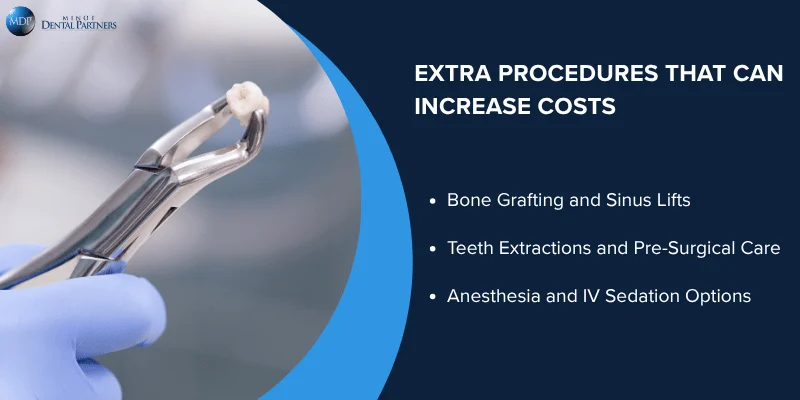
Bone Grafting and Sinus Lifts
Your jawbone needs enough density and height to support dental implants. If you’ve been missing teeth for a while, your bone may have shrunk or deteriorated.
This means you’ll likely need a bone graft before your dentist can place the implants.
A bone graft involves adding material to your jaw to build it back up. The cost typically ranges from $300 to $1,200 per area that needs grafting. Some patients need multiple grafts, which increases the total expense.
For upper jaw implants, you might also need a sinus lift. This procedure raises the sinus floor to create more room for the implant posts. Sinus lifts usually cost between $1,500 and $2,500 per side.
These procedures like bone grafting can increase costs unexpectedly. Your dentist will assess your bone structure during the initial consultation to determine if you need these treatments.
Teeth Extractions and Pre-Surgical Care
If you still have damaged or decayed teeth, they’ll need to come out before implant surgery. Simple extractions might cost $75 to $300 per tooth. Surgical extractions for teeth that are broken or impacted can run $200 to $600 each.
Some patients need all remaining teeth removed, which adds up quickly. Your dentist might also prescribe antibiotics or other medications before surgery to prevent infection.
Pre-surgical care can include X-rays, CT scans, and molds of your mouth. These diagnostic tools help your dentist plan the exact placement of your implants. The imaging alone can add $300 to $800 to your treatment cost.
Anesthesia and IV Sedation Options
You’ll need some form of pain management during the procedure. Local anesthesia is usually included in the base price, but many patients prefer deeper sedation for comfort.
IV sedation lets you relax or sleep through the surgery while remaining responsive. This option typically costs $500 to $1,000 per hour. Most All-on-4 procedures take two to three hours per arch.
General anesthesia is another choice, though it’s less common for this type of implant surgery. It requires an anesthesiologist and costs more than IV sedation.
Your choice depends on your anxiety level, medical history, and how long the procedure will take.
Comparing All-on-4 to Traditional Solutions
All-on-4 implants use just four strategically placed posts per arch, while traditional approaches often require six to ten implants plus bone grafting.
The choice between these methods affects your treatment timeline, surgical complexity, and total investment in your smile.
All-on-4 vs. Traditional Dental Implants
Traditional dental implants typically need more individual posts to support a full arch of teeth. Your dentist might place six to ten conventional implants, which means more surgical sites and a longer procedure.
Traditional implants require multiple procedures that can extend your treatment over several months. You’ll often need bone grafting if your jawbone has thinned, adding both time and expense to the process.
Each traditional implant gets its own crown or connects to a bridge.
All-on-4 works differently by angling the back implants to maximize contact with existing bone. This approach usually eliminates the need for bone grafting.
You can often receive temporary teeth the same day as your surgery.
The cost difference is significant. Traditional full-mouth restoration with individual implants can exceed the All-on-4 price because you’re paying for more implant posts, more surgical time, and potentially expensive grafting procedures.
Removable and Traditional Dentures Considerations
Removable dentures represent the most affordable initial option for replacing missing teeth. Traditional dentures sit on your gums and rely on suction or adhesives to stay in place.
You’ll face ongoing costs with removable dentures that aren’t immediately obvious.
Your jawbone gradually shrinks without tooth roots to stimulate it, requiring frequent adjustments and replacements every five to seven years. Denture adhesives add to your monthly expenses.
Traditional dentures restore only about 20% of your natural chewing power. You’ll need to avoid certain foods and may experience slipping while eating or speaking.
All-on-4 implants are fixed permanently in your mouth and don’t require removal for cleaning. They preserve your jawbone and restore up to 80% of your natural bite force.
While the upfront investment is higher, you avoid the recurring costs and limitations of removable dentures.
Full-Arch and Full-Mouth Restoration Alternatives
Full-arch restoration refers to replacing all teeth in one jaw (upper or lower). Full-mouth restoration addresses both arches at once. Your treatment needs depend on how many teeth you’re replacing.
All-on-4 provides full-arch restoration using four implants per jaw. Some patients choose to treat only their upper or lower arch initially, while others complete both arches simultaneously.
Alternative approaches include implant-supported overdentures, which snap onto two to four implants but remain removable. These cost less than fixed All-on-4 but don’t provide the same stability or bone preservation.
Full mouth implants with individual crowns for each tooth position offer maximum customization but require the most implants and highest investment.
This approach makes sense if you have excellent bone density and prefer teeth that can be individually serviced if problems arise.
The best choice for your situation depends on your bone quality, budget, and how quickly you need functional teeth.
In smaller cities like Minot, dentists who offer multiple restoration options can help you compare what each approach means for your specific needs.
Financing Strategies and Insurance Factors
Most dental insurance plans offer limited coverage for All-on-4 dental implants, but various payment plans and financing options can make the procedure more affordable in cities like Minot.
Understanding what your insurance covers and exploring third-party lenders can help you manage the $20,000 to $40,000 cost.
Understanding Dental Insurance Coverage
Your dental insurance coverage typically treats All-on-4 as a cosmetic procedure rather than a medical necessity. Most plans cover only 25% to 50% of the implant procedure cost, if anything at all.
Some insurance policies will pay for individual components like extractions or bone grafting.
You might get coverage for the prosthetic teeth portion since insurance companies sometimes classify these as dentures. Contact your provider before scheduling to understand exactly what they’ll cover.
Common coverage scenarios:
- Extraction procedures: Often fully or partially covered
- Bone grafting: May qualify under restorative benefits
- Final prosthetics: Sometimes covered as dentures
- Implant posts: Rarely covered by traditional plans
In Minot, you should request a pre-authorization from your insurance company. This gives you a written breakdown of what they’ll pay before you commit to the procedure.
Exploring Payment Plans and Dental Financing Options
Most dental offices in smaller cities offer in-house dental financing and payment plans that break down the all-on-4 cost into manageable monthly payments.
These arrangements often require no credit check or have more flexible approval requirements than traditional loans.
You can spread payments over 12 to 60 months depending on the practice’s policies. Interest rates vary from 0% promotional periods to 8-15% for longer terms.
Health Savings Accounts (HSAs) and Flexible Spending Accounts (FSAs) let you use pre-tax dollars for the procedure.
This effectively reduces your all-on-4 dental implants cost by your tax rate, which could save you $5,000 to $10,000.
Ask your dentist about:
- Zero-interest promotional periods (usually 6-18 months)
- Extended payment terms with fixed monthly amounts
- Down payment requirements
- Early payoff penalties or benefits
The Role of CareCredit and Third-Party Lenders
CareCredit is the most popular third-party lender for dental implant costs, offering promotional financing with no interest if you pay within 6, 12, or 24 months.
You’ll need a credit score above 600 for approval, though higher scores unlock better terms.
Other medical lenders include LendingClub, Prosper, and Cherry Financial. These companies specialize in healthcare financing and often approve patients who traditional banks might reject.
Comparison of lending options:
| Lender Type | Interest Rate | Approval Speed | Credit Requirement |
| CareCredit | 0-26.99% | Same day | 600+ score |
| Bank loans | 6-12% | 3-7 days | 680+ score |
| Credit unions | 5-10% | 1-3 days | 650+ score |
Third-party financing typically covers the full all-on-4 price, including consultations and follow-up care. The application process takes minutes, and many Minot dentists can process approvals during your initial visit.
Dental Tourism and Price Comparison
Dental tourism involves traveling to countries like Mexico, Costa Rica, or Thailand where the cost of all on 4 procedures runs $8,000 to $15,000. This represents a 50-65% savings compared to U.S. prices.
You need to factor in travel costs, lodging, and time away from work. Multiple trips might be necessary for follow-up appointments, which adds to the total expense.
Quality standards and legal protections differ significantly outside the United States. If complications arise after you return home, finding a local dentist willing to fix another provider’s work can be difficult and expensive.
Risks to consider:
- Limited legal recourse for malpractice
- Different sterilization and safety standards
- Communication barriers
- Warranty and guarantee enforcement challenges
Some Minot patients find better value by comparing all-on-4 dental implant cost between nearby cities rather than traveling internationally.
Regional price differences within North Dakota and neighboring states are often smaller than advertised, especially when you include travel expenses.
Long-Term Value and Maintenance Considerations
All-on-4 implants require ongoing care to last their full lifespan, and understanding these maintenance needs helps you budget accurately beyond the initial procedure cost.
Maintenance and Longevity of All-on-4 Implants
All-on-4 implants maintenance involves both daily home care and regular dental visits. You’ll need to clean your implants with specialized tools like interdental brushes and water flossers to prevent buildup around the implant sites.
Professional maintenance visits should happen every 3-6 months. During these appointments, your dentist checks the implant stability and cleans areas you can’t reach at home.
These visits cost less in smaller cities like Minot compared to major metropolitan areas.
Your all-on-4 consultation should include discussion about maintenance requirements. The clinical benefits of all-on-4 implants become most apparent over 10-20 years through bone preservation and maintained bite force.
Success depends on how well you maintain your implants at home and keep up with professional cleanings.
Planning for Repairs and Replacement Down the Road
The prosthetic teeth attached to your implants typically need replacement every 5-15 years depending on wear and material quality. While teeth in a day procedures give you immediate results, the components won’t last forever.
Budget for these future costs when considering your initial investment:
- Prosthetic replacement: $3,000-$8,000 per arch
- Maintenance visits: $150-$300 per visit
- Specialized cleaning tools: $50-$100 annually
- Minor repairs: $500-$1,500 as needed
In smaller cities like Minot, these replacement and repair costs run 20-30% lower than in larger urban areas. Your dentist can provide a maintenance schedule during your consultation to help you plan financially for long-term care.
Frequently Asked Questions
Cost differences between clinics often come down to dentist experience, materials chosen, and what extra procedures you might need. Understanding these factors helps you compare quotes and plan your budget.
What factors make All-on-4 dental implant prices vary from one clinic to another in a smaller city?
The dentist’s experience and training level can create price differences between clinics. A specialist who has placed hundreds of All-on-4 cases may charge more than someone newer to the procedure.
The clinic’s overhead costs also play a role. Some practices invest in advanced technology like 3D imaging or digital treatment planning, which can raise prices but may improve your results.
Staff expertise matters too. Clinics with experienced surgical teams and lab technicians might include those costs in their fees.
The type of prosthetic material used affects pricing as well, with acrylic options typically costing less than zirconia bridges.
How much does the type of implant brand and materials used affect the total cost?
Premium implant brands like Nobel Biocare and Straumann typically cost more than other options. These brands often have longer track records and extensive research backing their products.
The prosthetic material you choose makes a significant difference in price. Acrylic prosthetics are the most budget-friendly option, while zirconia bridges cost more but offer better durability and a more natural appearance.
Some clinics use higher-grade titanium alloys for the implants themselves. These materials can add to the total cost but may provide better long-term stability in your jawbone.
Do I need bone grafting or extractions, and how do those steps change the final price?
Your jawbone density determines whether you need bone grafting before implant placement. If your bone isn’t strong enough to support implants, grafting procedures can add several thousand dollars to your total cost.
Tooth extractions add to the price if you still have teeth that need removal. Simple extractions cost less than surgical extractions for broken or impacted teeth.
Some patients need gum treatments before implants to address periodontal disease. These preparatory steps increase the timeline and budget for your treatment.
What’s usually included in an All-on-4 quote (surgery, temporary teeth, final bridge, follow-up visits)?
Most All-on-4 quotes include the surgical placement of four implants per arch and a temporary prosthetic you wear the same day. Initial consultations and necessary imaging like CT scans are often part of the package.
Your final permanent bridge is typically included in the total price, though some clinics separate this cost. Follow-up appointments for the first few months usually come with your treatment fee.
Some quotes include adjustments to your temporary teeth while you heal. You should ask specifically about what’s covered because what’s included in the total cost varies between practices.
How does dental insurance—like Delta Dental—typically help with implant or denture-related costs?
Most dental insurance plans provide limited coverage for implants, if any at all. Delta Dental and similar carriers may classify All-on-4 as cosmetic rather than medically necessary.
Some plans cover a portion of the procedure by treating it as a denture alternative. You might get coverage for extractions or bone grafting even if the implants themselves aren’t covered.
Annual maximum benefits limit how much your insurance pays in a calendar year. Many plans cap at $1,500 to $2,000 annually, which covers only a small fraction of All-on-4 costs.
Are there financing options or payment plans that can make All-on-4 treatment more affordable locally?
Many dental offices offer in-house payment plans that let you spread costs over several months or years. These arrangements may not charge interest if you pay within a specific timeframe.
Third-party healthcare financing companies like CareCredit provide loans specifically for medical and dental procedures. Interest rates vary based on your credit score and the repayment period you choose.
Health Savings Accounts let you use pre-tax dollars for dental implants. Some local practices also work with dental schools or community programs that offer reduced fees for qualifying patients.