



If you have osteoporosis, you may wonder if dental implants will hold. Bone loss can affect how well an implant bonds with your jaw. That is why the right bone tests matter before you move forward.
The most important bone test before dental implants is a DEXA scan to measure bone density, along with 3D dental imaging to check jawbone volume and quality.
These tests show how strong your bones are and whether your jaw can support an implant. They also help your dentist plan safely if you take medications that affect bone turnover.
When you understand the osteoporosis dental implant eligibility, you gain more control over your treatment. You can plan with confidence and lower your risk of implant problems.
Key Takeaways
- Bone density and jaw imaging guide safe implant planning.
- Careful testing helps lower the risk of implant failure.
- The right plan can improve long-term implant stability.
How Osteoporosis Influences Dental Implant Success
Osteoporosis changes the way your bone heals and holds onto an implant. Your bone density, jawbone volume, and the medications you take all shape how well dental implants integrate and stay stable.
Impact of Bone Density on Implant Integration
Dental implants depend on osseointegration, the process where your jawbone grows tightly around the implant surface. If you have osteoporosis, your bone density may be lower, which can slow this process.
Lower density does not always mean failure. Research such as this systematic review on osteoporosis and dental implant survival shows mixed results. Many people with osteoporosis still achieve good implant survival rates.
What matters most is the quality and volume of bone in your jaw, not just your overall diagnosis. Your dentist may use imaging, such as 3D scans, to measure bone thickness and structure at the exact implant site.
If bone density is low in that area, your provider may adjust the plan. Options include:
- Using longer or wider implants
- Placing implants in denser parts of the jaw
- Staging treatment to allow more healing time
Bone Loss and Implant Stability in the Jawbone
Osteoporosis affects bone metabolism, which can increase the risk of jawbone loss over time. Implant success depends on keeping strong contact between the implant and your jawbone.
Your provider checks two main factors:
| Factor | Why It Matters |
| Initial stability | The implant must feel firm at placement. |
| Marginal bone levels | Bone around the implant neck should remain stable. |
Some research, including a review of dental implants in patients with osteoporosis, suggests that reduced bone quality may affect healing in certain cases. Still, many patients with controlled osteoporosis maintain stable implants for years.
If you already have bone loss in the jaw, your dentist may recommend bone grafting. This builds up volume and improves implant stability before placement.
Role of Bisphosphonates and Medication-Related Risks
If you take bisphosphonates or other bone-modifying drugs, you need a careful evaluation before implant surgery. These medications slow bone breakdown, which helps treat osteoporosis. However, they can also affect healing.
One concern is osteonecrosis of the jaw (ONJ). This rare condition involves exposed jawbone that does not heal properly. A review on the association between dental implants, osteoporosis, and bone-modulating therapy notes that evidence is mixed, but risk appears higher with certain drug types and long-term use.
Your risk depends on:
- Whether you take oral or IV medication
- How long have you used it
- Your overall health
You should always share your full medication history. Your dentist and physician may coordinate care, adjust timing, or monitor healing closely to lower your risk.
Essential Bone Tests Before Dental Implant Placement
Before you place a dental implant, your dentist needs clear proof that your jaw can support it. Bone density scans, detailed imaging, and specific blood tests help measure bone strength, bone volume, and your ability to heal.
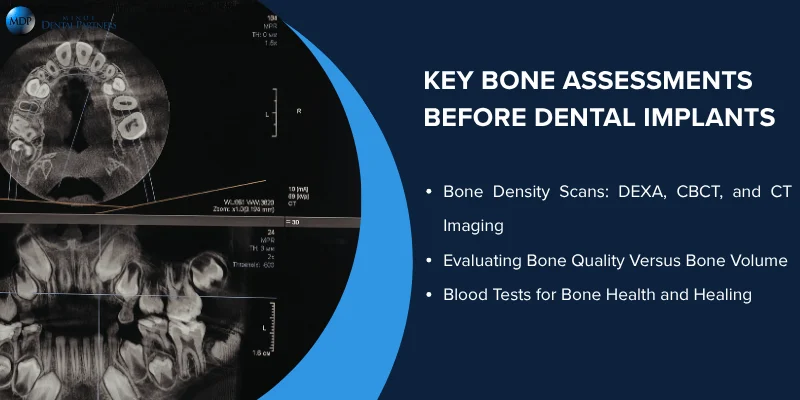
Bone Density Scans: DEXA, CBCT, and CT Imaging
Bone density scans measure how strong your bones are. If you have osteoporosis, your dentist may review a recent DEXA scan. A DEXA scan checks overall bone mineral density and helps show how severe your bone loss is.
Many providers recommend bone density scans such as DEXA before implant surgery to guide treatment planning.
For your jaw, your dentist often uses CBCT (cone beam computed tomography). This 3D imaging shows the exact shape and thickness of your jawbone. It helps measure bone height, width, and the position of nerves and sinuses.
In some cases, CT imaging offers more detail. These scans give cross‑section views of the bone. They help your dentist decide if you need major bone grafting before implant placement.
Evaluating Bone Quality Versus Bone Volume
You need both enough bone and strong bone. These are not the same thing.
Bone volume means how much bone you have. Your dentist checks:
- Bone height
- Bone width
- Space between key structures
If your jaw lacks volume, you may need a graft to build it up. Many experts stress that sufficient bone volume in the jaw is critical for implant stability.
Bone quality refers to bone density and internal structure. Even if you have enough bone, weak bone may not hold the implant well. Research on the impact of osteoporosis on dental implant survival shows that results vary, so careful evaluation matters.
Your dentist studies imaging closely to judge how well your bone can support osseointegration, which is the process where bone bonds to the implant.
Blood Tests for Bone Health and Healing
Blood tests help your dentist understand how well your body can heal. This matters because implants rely on healthy bone healing after placement.
Some providers check bone turnover markers. These markers show how fast your bone breaks down and rebuilds.
Your doctor may also review:
- Vitamin D levels
- Calcium levels
- Parathyroid hormone levels
Low vitamin D or poor calcium balance can slow healing. If you take antiresorptive drugs, your dental team may coordinate with your physician to lower the risk of problems such as medication-related jaw issues.
By checking bone health through imaging and blood tests, your care team can adjust timing, grafting, or medication plans to improve healing and implant success.
Pre-Implant Treatment Planning for Osteoporosis Patients
Careful planning lowers risk and improves implant success rates. You need clear medical details, open communication between providers, and a risk review based on your bone health and daily habits.
Medical History and Medication Review

Your dentist or oral surgeon will start with a detailed medical history. You should list all health conditions, not just osteoporosis. Diabetes, autoimmune disease, and smoking can affect healing after dental implant surgery.
Medication review is critical. Many patients with osteoporosis take bisphosphonates or denosumab. These drugs help bone strength but may affect jaw healing in rare cases. You must share how long you have taken them, the dose, and whether you receive pills or injections.
Your provider may also ask about steroids, blood thinners, or cancer treatments. Each drug can change your surgical plan.
Accurate records help your team weigh the real risks of osteoporosis and dental implants. They can adjust timing, choose implant type, or plan closer follow-up visits.
Team Approach: Dentist and Physician Coordination
You benefit when your dentist and primary care doctor or endocrinologist work together. This team approach helps protect both your jawbone and your overall bone health.
Your physician can confirm your latest DEXA results and explain your fracture risk. Some clinics stress careful planning and coordination for implant care in patients with bone loss.
In some cases, your doctors may adjust the timing of medication doses around surgery. You should never stop medication on your own.
Clear communication between your oral surgeon and physician supports safer dental implant surgery and helps maintain stable bone during healing.
Individualized Risk Assessment
Not all osteoporosis cases carry the same risk. Your provider will assess your bone density, jawbone volume, and bone quality, not just your diagnosis.
Research suggests that osteoporosis alone does not automatically reduce implant survival. This means your personal risk depends on more than one factor.
Your team will consider:
- DEXA scan results
- Jaw imaging from 3D scans
- Smoking and alcohol use
- Oral hygiene habits
- Past healing after surgeries
They may also discuss whether bone grafting or shorter implants fit your case. When your plan matches your specific health profile, you improve your chances of stable healing and long-term implant success rates.
Solutions for Inadequate Bone: Grafting and Augmentation
If your bone is too thin or soft for a stable implant, your dentist may rebuild it before or during implant placement. Bone grafting restores lost alveolar bone and creates a stronger base for long-term support.
Autograft, Allograft, and Synthetic Graft Options
You have several bone graft options, and each works differently.
An autograft uses your own bone, often taken from the jaw or another small donor site. Because it contains your living cells, it supports strong bone healing and natural bone remodeling. It often integrates well, but it requires a second surgical area.
An allograft uses donated human bone that has been processed for safety. It does not contain living cells, but it acts as a scaffold. Your body slowly replaces it with new bone over time.
A synthetic graft uses man‑made materials such as calcium phosphate. These materials guide new bone growth and avoid the need for a donor site.
Many modern techniques combine materials to improve results. Research in bone regeneration strategies shows that different graft types offer specific benefits depending on the defect size and location.
Criteria for Bone Grafting in Implant Candidates
Your dentist recommends bone grafting when your alveolar bone cannot hold an implant securely.
Common reasons include bone loss from gum disease, tooth loss, or long‑term denture use. Osteoporosis can also lower bone density and affect implant planning. Studies show that patients with low bone density can still achieve good outcomes with proper planning.
You may need grafting if imaging shows:
- Insufficient bone height near the sinus
- Narrow bone width in the jaw
- Poor bone quality that reduces primary stability
Your provider will review your bone density scan, medical history, and medications before making a decision.
Supporting Osseointegration After Grafting
After bone graft surgery, your body begins bone healing through controlled bone remodeling.
New blood vessels grow into the graft. Your natural bone cells replace or blend with the graft material. This process can take several months, depending on the graft type and the size of the defect.
Your role matters. You must keep the area clean, avoid smoking, and follow diet and medication instructions. Good oral hygiene reduces infection risk, which protects the graft during early healing.
Research on the effects of osteoporosis on dental implant osseointegration and survival shows that long‑term outcomes depend on stable integration between the implant and surrounding bone.
Careful planning, proper graft choice, and healthy bone healing give your implant the support it needs to last.
Keys to Long-Term Success: Maintenance and Recovery
Strong daily care, steady nutrition, and regular dental visits protect your implant and the bone around it. When you manage these steps well, you lower your risk of implant failure and support stable healing.

Oral Hygiene and Preventive Strategies
You protect your dental implant the same way you protect natural teeth: with steady oral hygiene. Brush twice a day with a soft toothbrush and clean around the implant crown and gumline with care.
Floss daily. If you have implant-supported dentures, use floss threaders, interdental brushes, or a water flosser to clean under the bar or bridge.
Plaque buildup can lead to peri-implant disease. This condition causes inflammation and bone loss around the implant. Bone loss raises the risk of implant failure, especially if you already have osteoporosis.
Focus on these basics:
- Brush for two full minutes
- Clean between teeth and implants daily
- Avoid smoking
- Schedule professional cleanings every 3–6 months
Dentists stress that long-term implant success depends on plaque control and risk management.
Nutritional Support: Calcium and Vitamin D
Your implant relies on bone stability. With osteoporosis, you must support bone health every day.
Calcium builds and maintains bone structure. Vitamin D helps your body absorb calcium and supports bone remodeling. Without enough vitamin D, your body cannot use calcium well.
Ask your doctor to check your blood vitamin D level. Many adults with osteoporosis need supplements, especially in winter months.
Focus on:
- Calcium-rich foods like dairy, fortified plant milks, and leafy greens
- Vitamin D from safe sun exposure, food, or supplements
- Adequate protein to support tissue healing
If you take osteoporosis medications, follow your physician’s plan closely. Well-managed medical status plays a role in implant stability. Coordinated care supports maintaining oral health with osteoporosis.
Post-Implant Monitoring and Follow-Up
You should not skip follow-up visits after tooth replacement with implants. Your dentist checks bone levels, gum health, and bite force at each visit.
X-rays help track changes in bone around the implant. This matters more if you have osteopenia or osteoporosis, since reduced bone density can affect long-term stability.
Regular exams often include:
- Checking for gum inflammation
- Measuring pocket depths around implants
- Reviewing home care techniques
- Evaluating implant-supported dentures for proper fit
Research on the impact of osteoporosis on dental implant survival and failure shows that bone health can influence outcomes. Early detection of bone loss allows your dentist to adjust care before small problems become major ones.
When you stay consistent with visits and home care, you give your implant the best chance to last for many years.
Frequently Asked Questions
Bone density, medication use, and bone quality all affect how well an implant bonds to your jaw. Clear testing and careful planning help you understand your risks and improve your outcome.
What are the bone density classifications for dental implants?
Dentists often describe jawbone density using the D1 to D4 system. This system looks at how dense and strong your bone is at the implant site.
- D1: Very dense bone, mostly hard cortical bone
- D2: Thick outer bone with strong inner bone
- D3: Thinner outer bone with softer inner bone
- D4: Very thin outer bone with soft, porous inner bone
Your dentist checks bone type with a 3D CT scan. This scan shows thickness, structure, and shape so your provider can plan implant size and placement.
How does osteoporosis medication affect the success of dental implants?
Some osteoporosis drugs, such as bisphosphonates and denosumab, can affect how your bone heals. In rare cases, they link to jawbone problems like osteonecrosis.
You should never stop these medications on your own. Your dentist and medical doctor need to review your dose, how long you have taken it, and your overall health before surgery.
Many patients still do well with implants. Careful screening lowers risk and improves safety.
Which bone density type is best suited for dental implants?
D2 bone often gives the most predictable results. It provides strong initial stability and supports healing.
D1 bone is very hard, which gives strength but may reduce blood supply slightly. D3 bone can still work well, but it may need slower healing time.
D4 bone is the most challenging because it is soft and porous. Your dentist may adjust the treatment plan if you have this bone type.
Is it possible to have dental implants if you’ve been diagnosed with osteoporosis?
Yes, many people with osteoporosis can still receive implants. A diagnosis alone does not disqualify you.
Modern imaging, such as CT scans and DEXA testing, helps your provider measure bone quality and overall bone mineral density. With proper planning, patients often achieve stable results. Healing may take longer. You may also need closer follow-up visits.
What are the differences between D1, D2, D3, and D4 bone types for dental implants?
The main difference is density and internal structure.
- D1: Very dense and mostly solid bone
- D2: Dense outer layer with strong inner support
- D3: Moderate density with softer inner bone
- D4: Low density and very soft inner bone
As density decreases, early implant stability can become harder to achieve. Your dentist may use wider implants, special surface treatments, or longer healing times for softer bone.
Are dental implants a viable option for patients with osteoporosis, and what precautions should be taken?
Dental implants are often a safe option if you complete a full evaluation. Your provider should review your DEXA results, CT scan, and medication history before making a plan.
Good oral hygiene, no smoking, and proper nutrition support healing. You should also attend all follow-up visits so your dentist can monitor bone integration.
Many clinics explain that osteoporosis does not automatically prevent treatment, especially with modern planning methods.